
Concurrent temporal channels for auditory processing: Oscillatory neural entrainment reveals segregation of function at different scales
MEG reveals how the brain follows fast and slow changes in sound at the same time.
Magnetoencephalography
MEG measures the tiny magnetic fields produced by brain activity, using sensors around the head. It lets us follow how the brain responds to speech, music, and rhythm from one moment to the next.
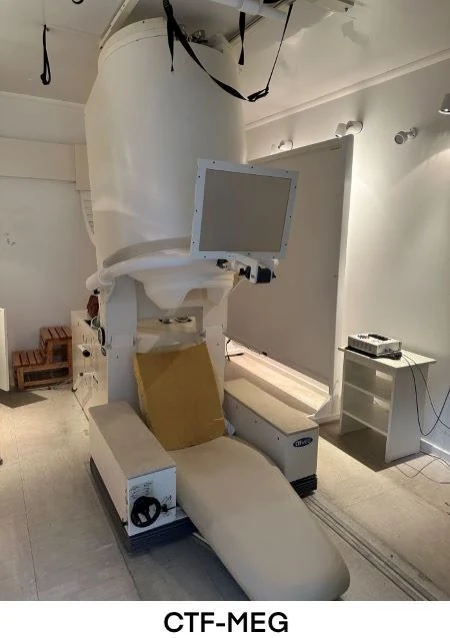
When brain cells communicate, their electrical activity produces tiny magnetic fields. MEG detects these fields with very sensitive sensors arranged around the head. A person sits or lies beneath a helmet-shaped scanner while listening to sounds or doing a task. The sensors record activity without entering the body.
How quickly does the brain respond to a sound? Does it follow a fast rhythm and a slow rhythm at the same time? MEG can follow changes from millisecond to millisecond, helping us study how the brain organizes speech, music, and other sounds as they unfold.
MEG reveals how the brain follows fast and slow changes in sound at the same time.