Publications

Ideas,
in print.

What we asked, what we found, and where to read more.

Select a word to explore related papers.

30 publications

2026

Language-Specific Tonal Features Drive Speaker–Listener Neural Synchronization

Hong, C., Teng, X., Li, Y., Hsu, S.-M., Tsao, F.-M., Wong, P. C. M., & Feng, G.

Journal of Neuroscience, 46(25), e1929252026.

Journal article

When someone tells a story in Mandarin, which parts of speech help the listener and speaker stay in step? Brain recordings showed that word-defining tones explained more of their shared activity than consonants, vowels or basic sound features, and this alignment predicted how well listeners understood the story.
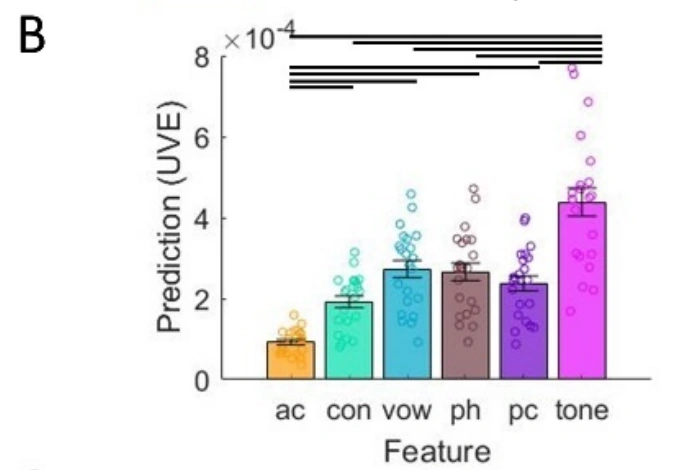
Bar plot comparing the unique neural-prediction contribution of acoustic, consonant, vowel, phoneme, pitch-contour and tone-category features. The tone-category bar is highest, with individual listener points and uncertainty bars retained.
Figure 4B (preprint)
2026

Neural and Behavioral Tracking of Musical Phrases Occurs Without Temporal Regularity

Hołubowska, Z. A., Teng, X., & Larrouy-Maestri, P.

European Journal of Neuroscience, 63(7), e70481.

Journal article

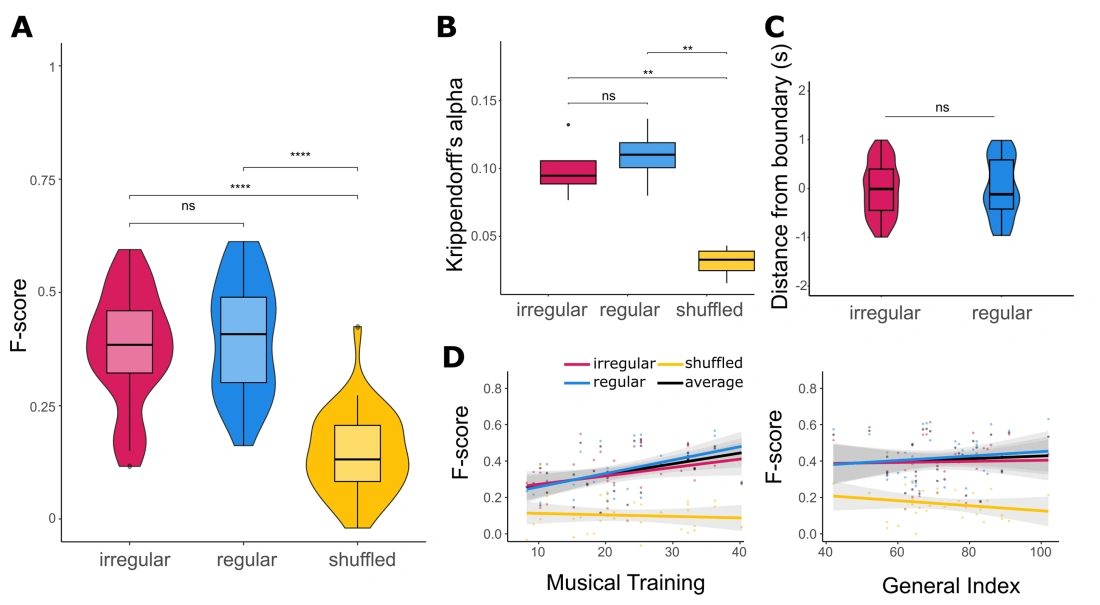
How do we hear musical phrases when they do not arrive at regular intervals? Listeners’ judgments and brain recordings tracked phrase boundaries even when their timing varied, suggesting that musical structure helps us divide music into meaningful parts.

Behavioral results comparing irregular, regular and shuffled melodies: boundary-detection F-scores, agreement among listeners, response timing and associations with musical training. Irregular and regular melodies have similar accuracy and outperform the shuffled condition.
Figure 2
2026

Short-Term Perceptual Training Modulates Neural Responses to Deepfake Speech But Does Not Improve Behavioral Discrimination

Yang, J., Jiang, H., Bai, Y., Ni, G., & Teng, X.

eNeuro, 13(3), ENEURO.0300-25.2026.

Journal article

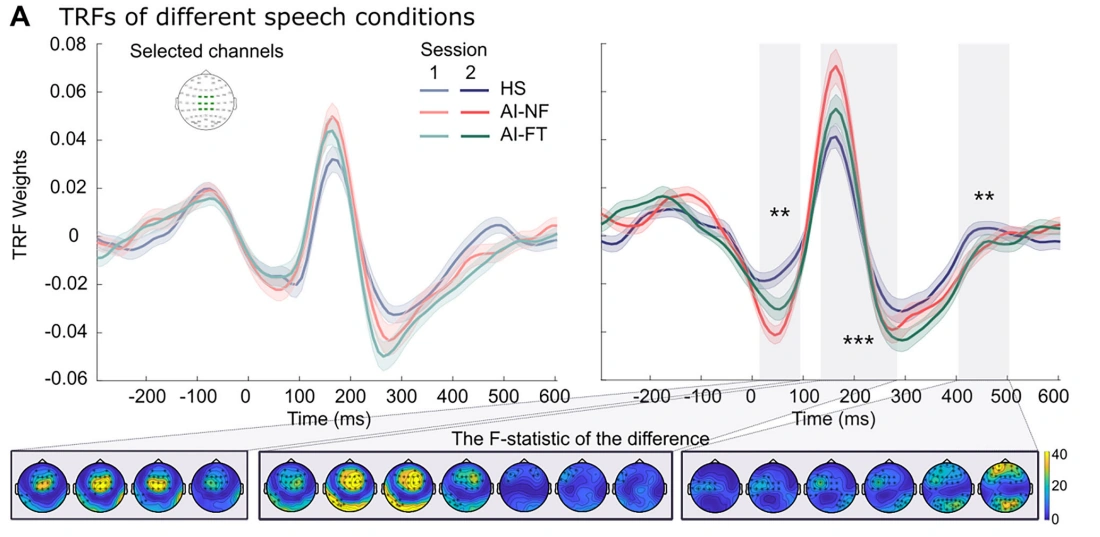
Can a short training session help people spot AI-cloned voices? Listeners remained poor at telling synthetic from human speech, even though their brain responses became more sensitive to differences after training.

In the media

  • Neuroscience NewsDeepfake Detection: Your Brain Hears the Difference Even When You Can’t
  • Tech XploreCan people distinguish between AI-generated and human speech?
  • NazologyAI音声、人は騙されるが”脳”は「違い」を見抜いていた
  • SpreekbuisOnderzoek: mensen kunnen AI-stemmen nauwelijks onderscheiden van menselijke spraak
Neural response curves for human speech, AI speech without fine-tuning and fine-tuned AI speech, before and after training. The post-training panel marks time intervals of significant differences and includes the original scalp maps and color legend.
Figure 2A
2026

Spoken language and attitudes in Hong Kong: English leads in prestige, Mandarin rises in employability, and Cantonese faces challenges

Cheung, L. M., & Teng, X.

PLOS ONE, 21(3), e0343611.

Journal article

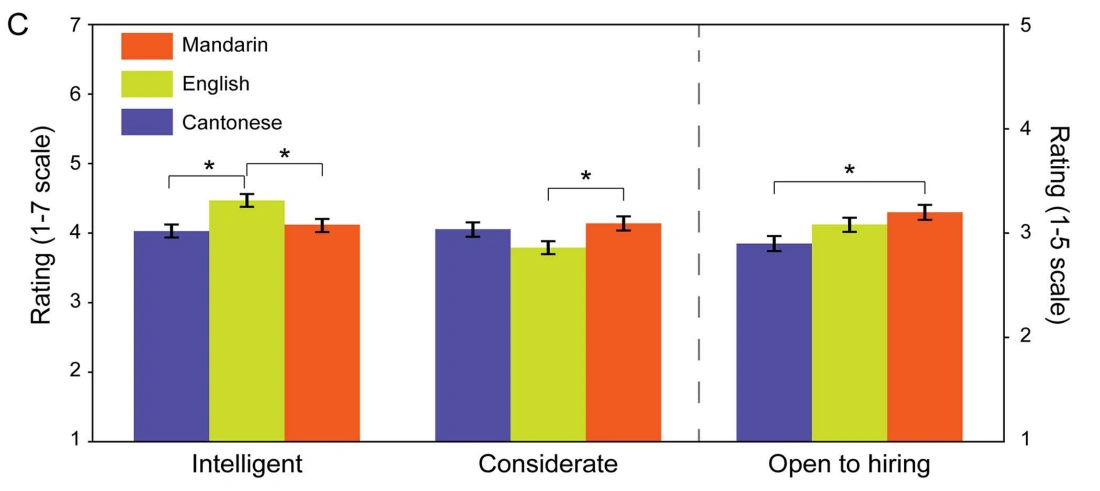
Can the language someone speaks change the impression they make? In an online study of 541 Hong Kong participants, English recordings received the highest intelligence and prestige ratings, Mandarin was favored for employability and goodwill, and Cantonese showed no distinctive advantage—revealing language-linked judgments rather than differences in speakers’ actual abilities.

Grouped bars compare Cantonese, English and Mandarin ratings. English receives higher intelligence ratings, Mandarin higher consideration than English and higher hiring ratings than Cantonese. Original seven-point and five-point rating axes, standard-error bars and significance brackets are retained.
Figure 1C
2026

Auditory tracking magnitude, temporal alignment, and anatomical distribution during wakefulness and propofol-based anesthesia

Zhu, H., Yao, C., Han, Z., Zhou, W., Wang, Y., Li, S., Wong, P. C. M., Tian, X., & Teng, X.

bioRxiv, version 2.

Preprint

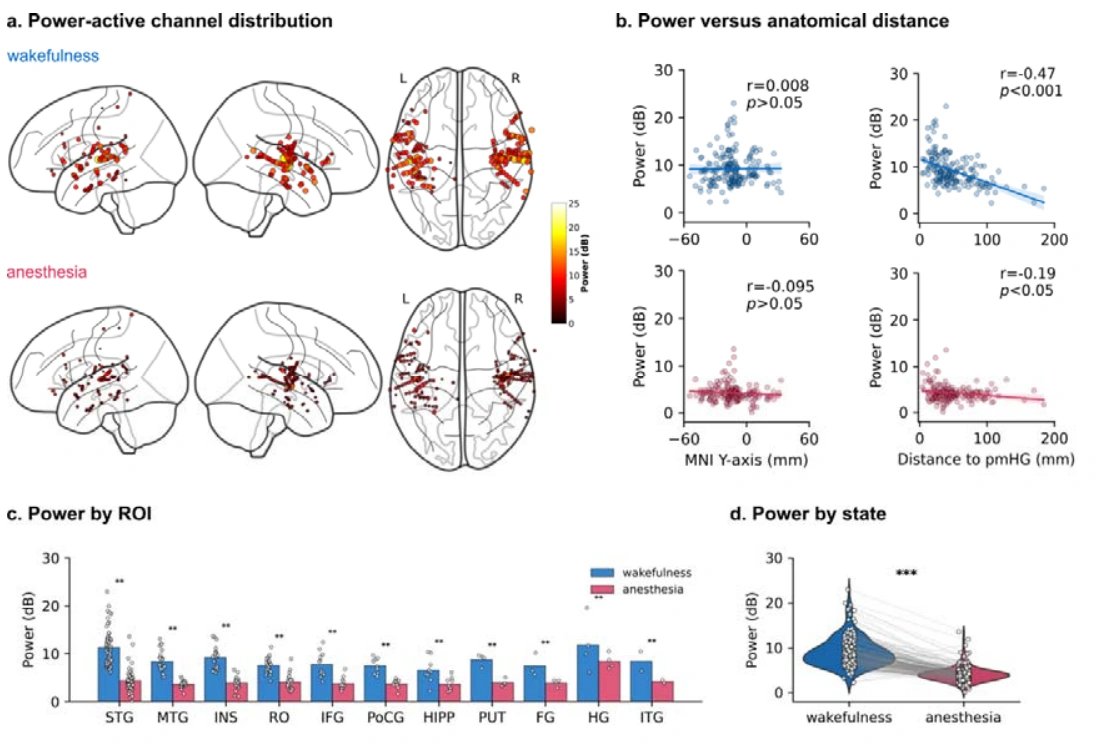
How does anesthesia change the brain’s response to rhythmic sounds? Recordings from 13 people being monitored for epilepsy showed weaker responses and less precise timing under anesthesia, although some brain activity still followed the sounds.

Four-panel figure compares wakefulness and anesthesia using brain maps, response power versus anatomical distance, power across brain regions and a paired state comparison. Blue wakefulness responses are generally stronger than pink anesthesia responses.
Figure 2 (preprint)
2026

Self-regulation shapes who benefits from large language models

Teng, X., & Ren, S.

PsyArXiv, version 2.

Preprint

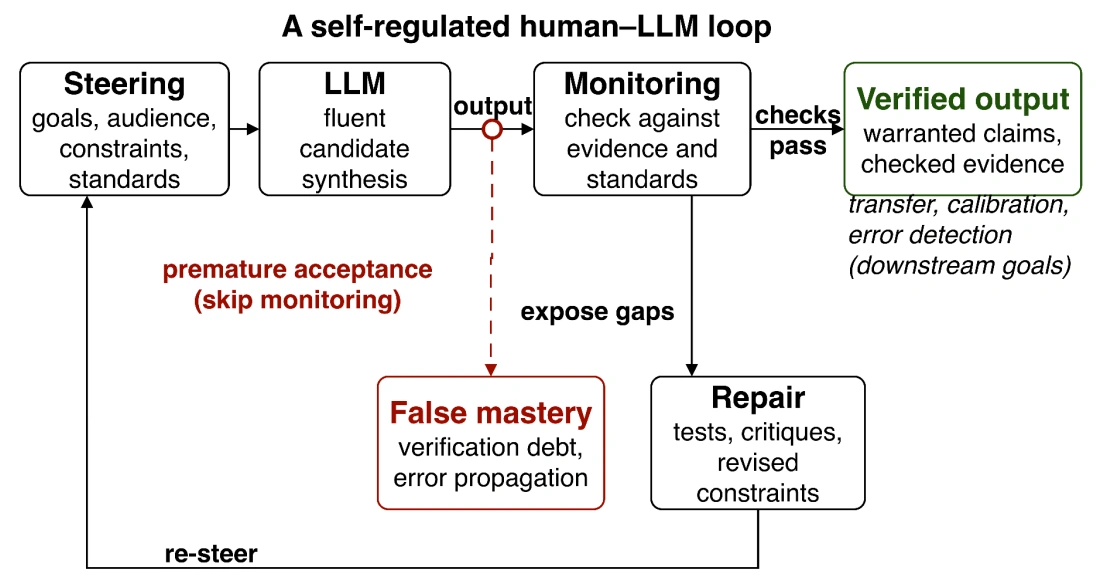
Why does the same AI tool help some people learn while leaving others with polished answers they do not understand? This perspective argues that the difference depends on how people set goals, check outputs and revise mistakes, together with the demands of the task and the support built into the tool.

Conceptual flow diagram: user goals steer an LLM; monitoring checks its candidate output; successful checks lead to verified output, while gaps trigger repair and revised instructions. A separate shortcut warns that skipping monitoring can produce false mastery.
Figure 1 (preprint)
2025

Eye blinks synchronize with musical beats during music listening

Wu, Y., Teng, X., & Du, Y.

PLOS Biology, 23(11), e3003456.

Journal article

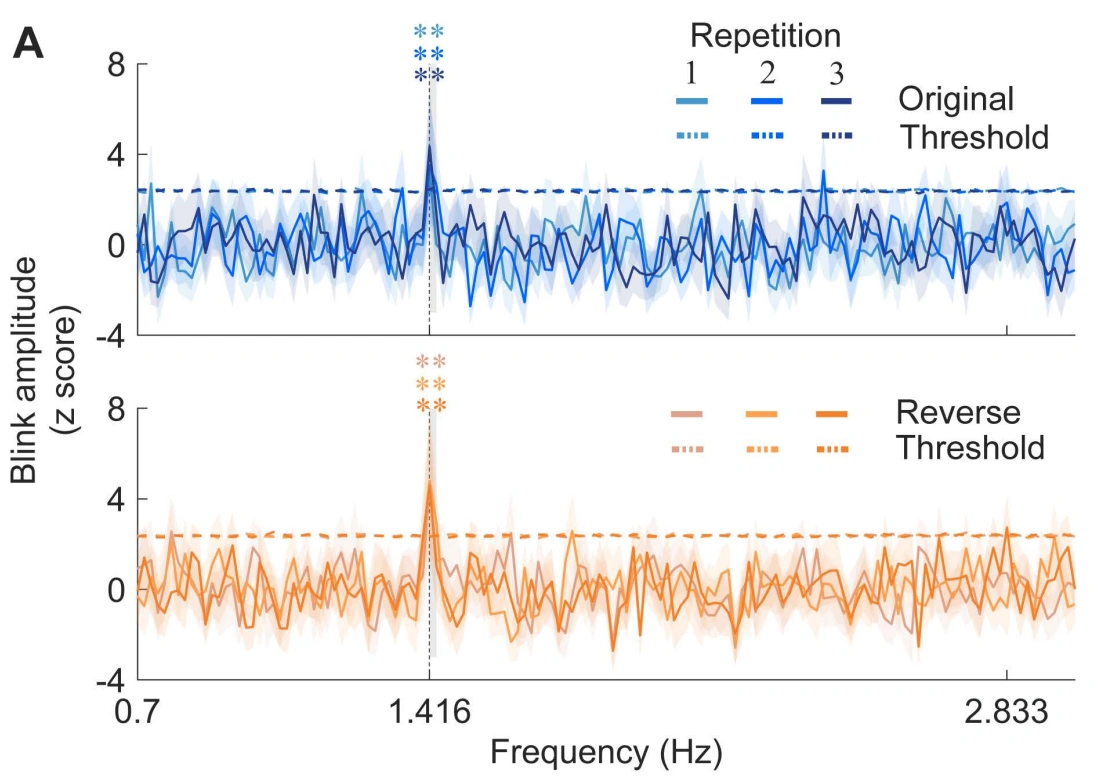
Our eyes can join in with a musical beat even when we are not deliberately moving to it. Across four experiments with 123 young nonmusicians, spontaneous blinks synchronized with beats, and their timing was linked to brain responses to rhythm and patterns of auditory attention.

In the media

Blink-frequency spectra for original and reversed music show prominent peaks at the beat frequency of 1.416 hertz. Three repetitions, standard-error shading and the original surrogate-test thresholds remain visible.
Figure 2A
2025

Sequential temporal anticipation characterized by neural power modulation and in recurrent neural networks

Teng, X., & Zhang, R. Y.

eLife, 13, RP99383.

Journal article

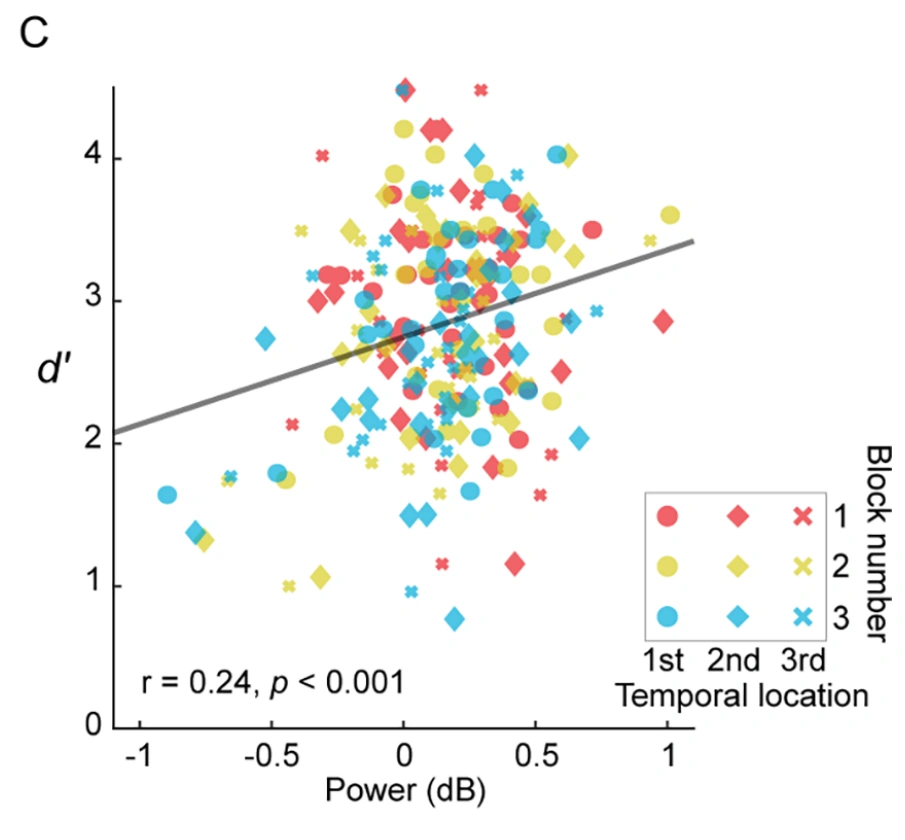
To study how we prepare for important moments, listeners learned when a faint tone might appear in background noise. Brain activity changed around those expected times and was linked to successful detection, while computer models suggested that anticipation also involves suppressing irrelevant noise between targets.

Scatter plot relates neural power to tone-detection sensitivity, d-prime, with a positive fitted relationship of r equals 0.24. Colors and symbols identify training blocks and three expected temporal locations.
Figure 3C
2025

Temporally Dissociable Neural Representations of Pitch Height and Chroma

Chang, A., Poeppel, D., & Teng, X.

Journal of Neuroscience, 45(8), e1567242024.

Journal article

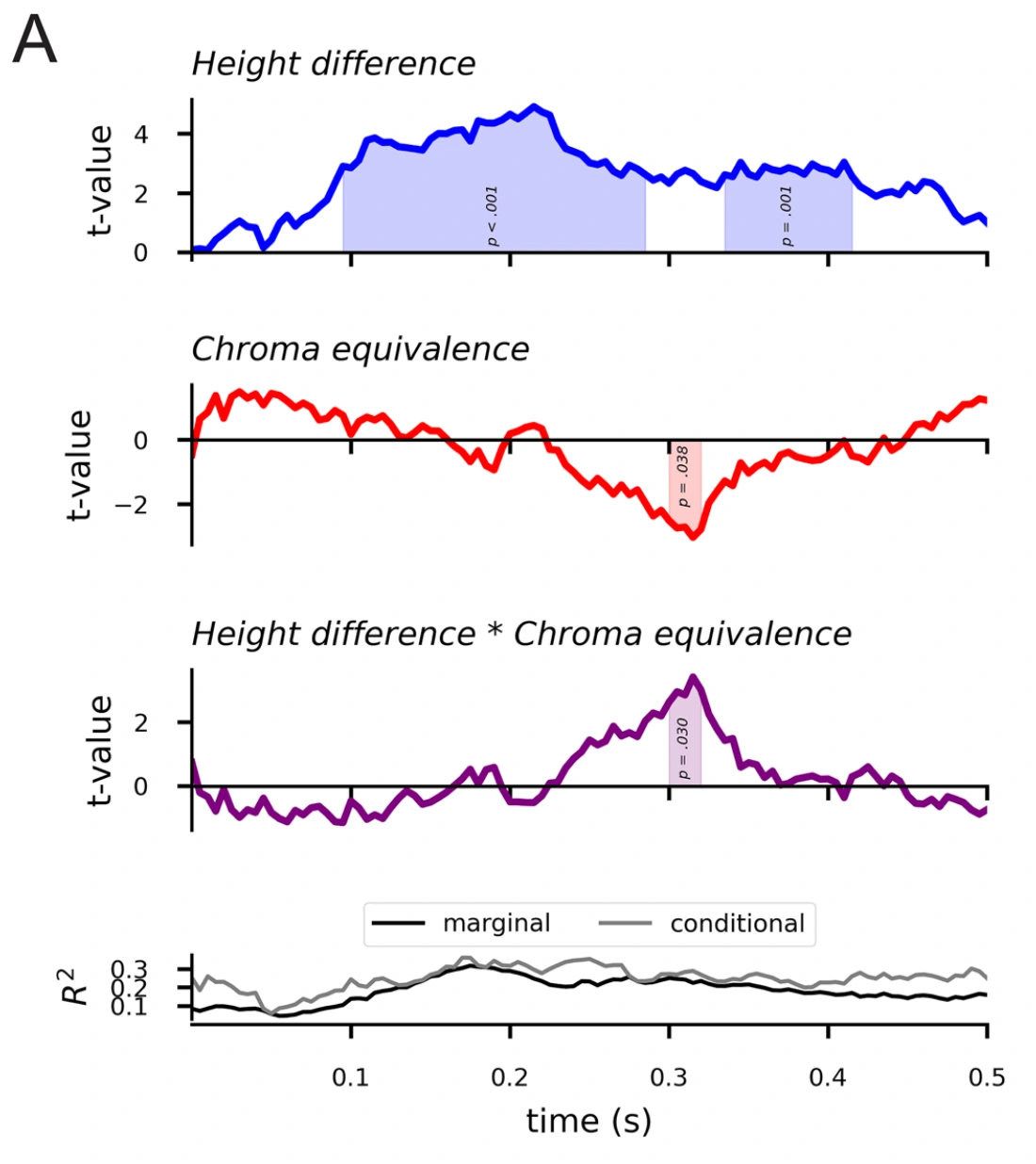
A note has both a height—how high or low it sounds—and a musical identity that repeats across octaves, such as C. Brain recordings showed different time courses for these two features: height appeared first and lasted longer, with a brief representation of note identity in between.

Time-course plots show model coefficients for pitch-height difference, chroma equivalence, and their interaction, with significant periods shaded and goodness-of-fit curves below.
Figure 3A
2025

Automatic binding of basic sensory features requires consciousness

Han, Z., Zhu, H., Chu, Q., Wu, Y., Chen, X., Wang, Y., Li, S., Teng, X., Wong, P. C. M., Yao, C., & Tian, X.

bioRxiv, version 1.

Preprint

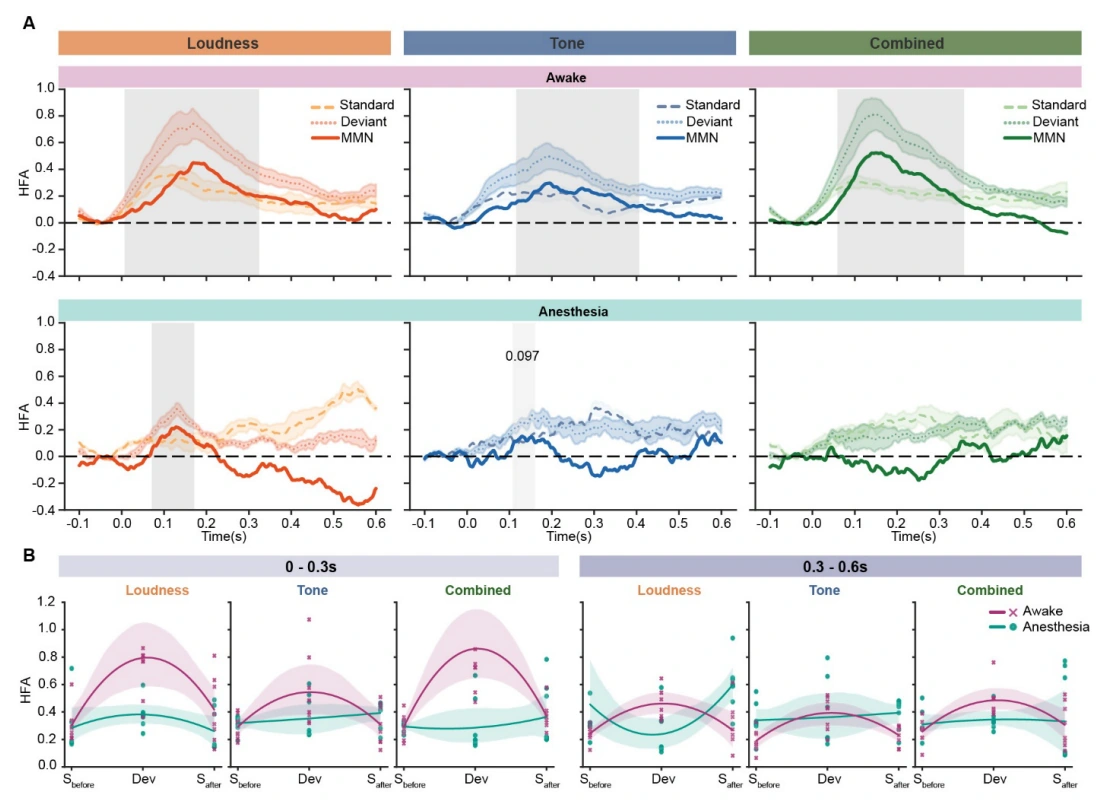
Researchers recorded brain activity while people were awake and anesthetized to ask how the brain combines a sound’s features. Under anesthesia, the brain still registered loudness and tone separately, but no longer showed the response to their combination observed when awake, suggesting a role for consciousness in joining simple features together.

Response curves for loudness, tone, and combined changes compare awake and anesthetized states, followed by early and late response comparisons.
Figure 4 (preprint)
2024

Effective network analysis in music listening based on electroencephalogram

Tan, Y., Sun, Z., Teng, X., Larrouy-Maestri, P., Duan, F., & Aoki, S.

Computers and Electrical Engineering, 117, 109191.

Journal article

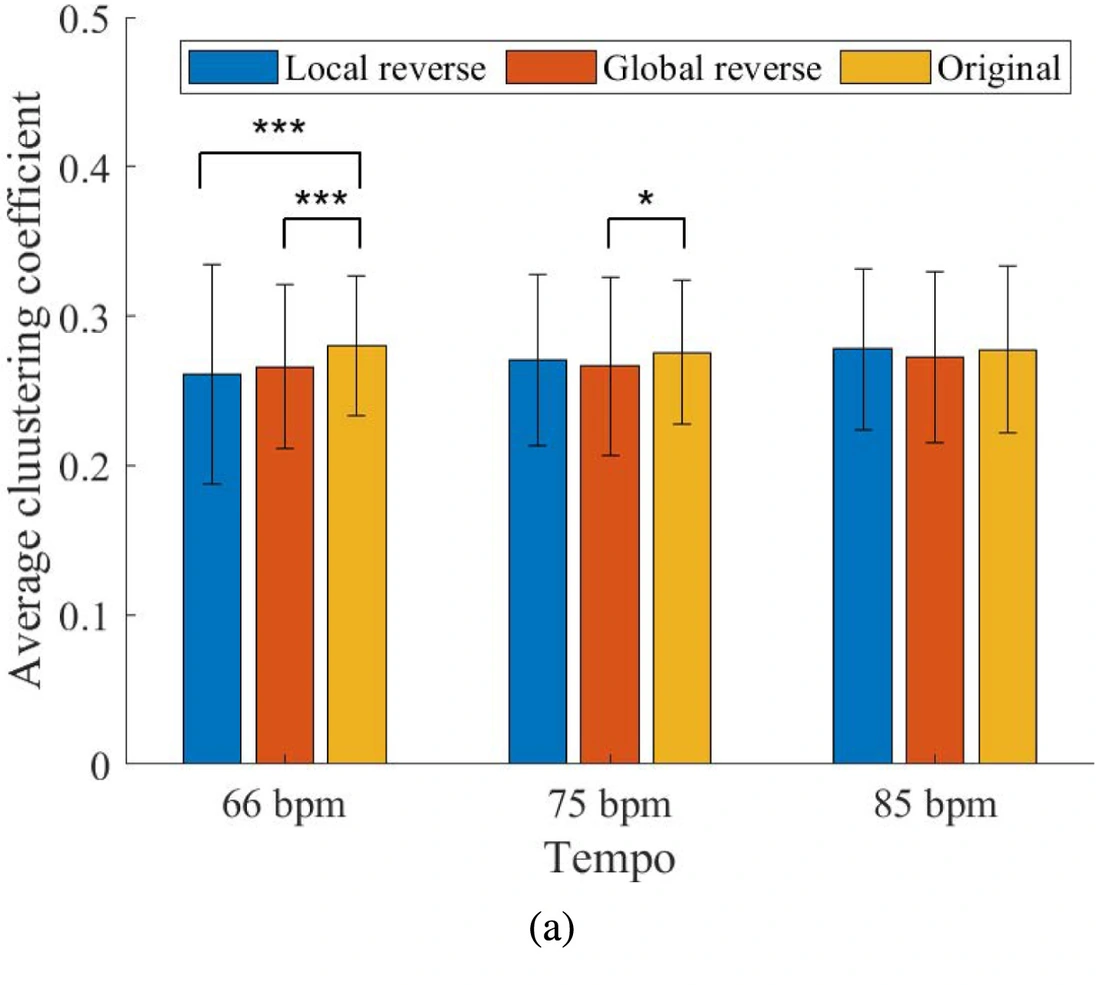
This study mapped how brain regions interact while people listen to music with different tempos and altered structures. Analysis of EEG recordings from 29 listeners found changes in estimated connections between regions, with the inferior parietal lobe standing out as an important network hub.

Bar chart compares average clustering coefficients for original, locally reversed, and globally reversed music at 66, 75, and 85 beats per minute; error bars, statistical markers, axes, and the legend are preserved.
Figure 6A
2024

Instrumental music training relates to intensity assessment but not emotional prosody recognition in Mandarin

Liu, M., Teng, X., & Jiang, J.

PLOS ONE, 19(8), e0309432.

Journal article

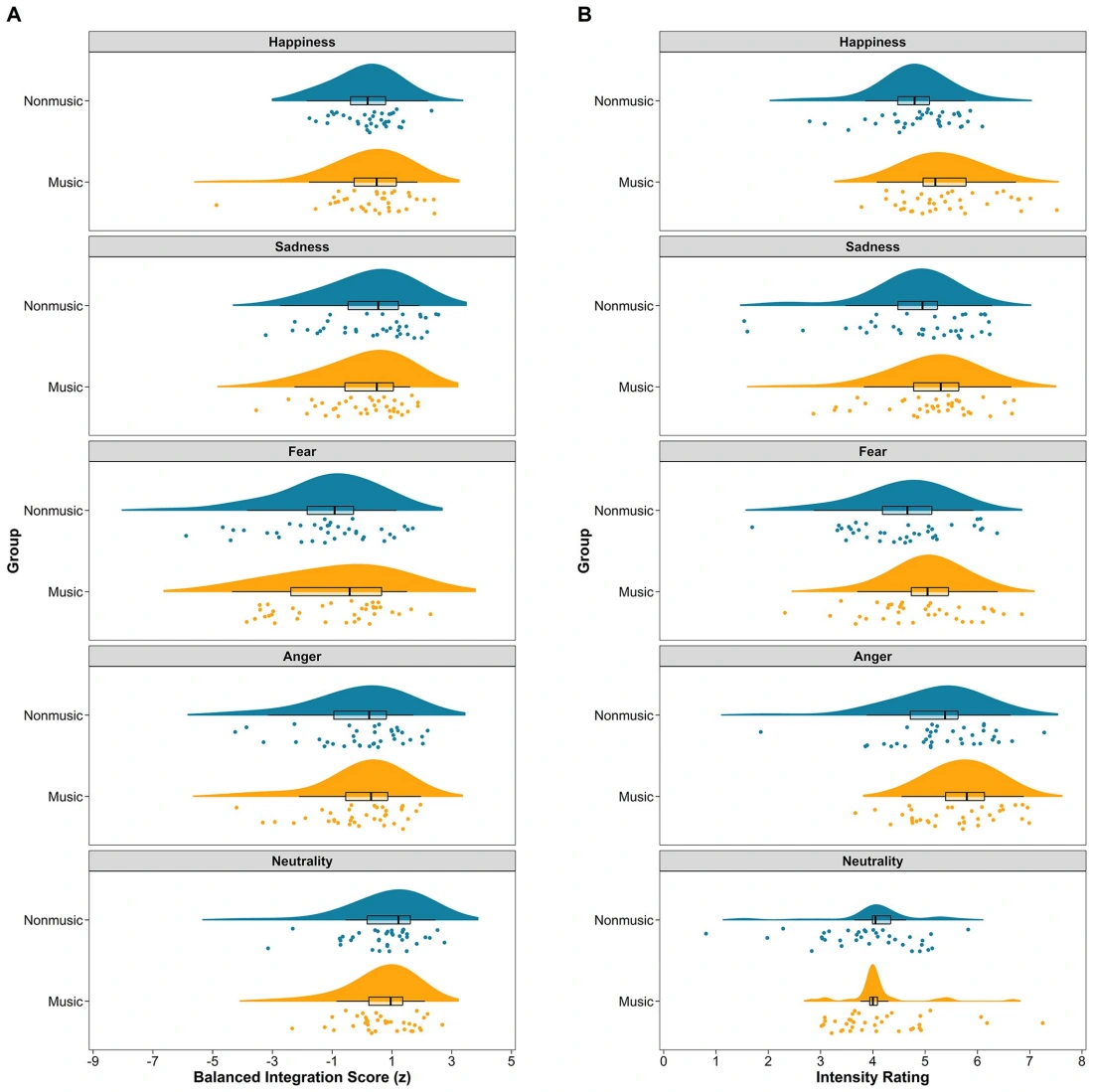
Does instrumental training help people hear emotion in Mandarin speech? Musicians and nonmusicians identified emotions similarly, but musicians rated happiness, fear and anger as more intense, suggesting a difference in emotional intensity judgments rather than an overall advantage in emotion recognition.

Raincloud plots show recognition scores and intensity ratings for five emotions, comparing music and control groups with individual observations and distribution summaries.
Figure 4
2024

Segmenting and Predicting Musical Phrase Structure Exploits Neural Gain Modulation and Phase Precession

Teng, X., Larrouy-Maestri, P., & Poeppel, D.

Journal of Neuroscience, 44(30), e1331232024.

Journal article

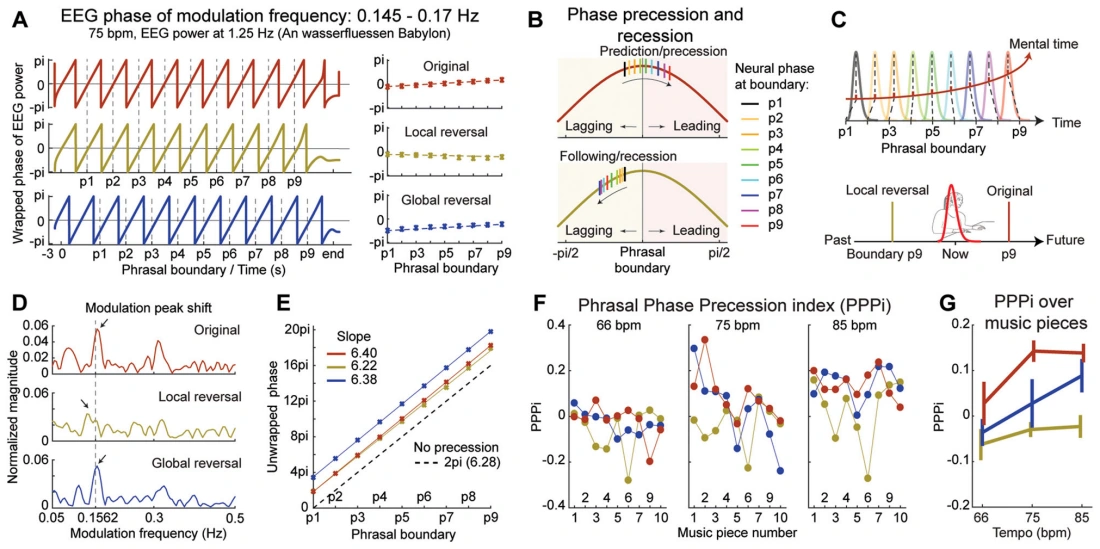
Using brain recordings while people listened to Bach chorales, this study examined how we divide music into phrases. Slow changes in brain activity tracked phrase boundaries and shifted ahead of them, consistent with listeners predicting the musical structure as it unfolded.

Time series, phase trajectories, and summary plots compare phrasal phase precession for original and reversed music at three tempi.
Figure 5
2024

The human auditory system uses amplitude modulation to distinguish music from speech

Chang, A., Teng, X., Assaneo, M. F., & Poeppel, D.

PLOS Biology, 22(5), e3002631.

Journal article

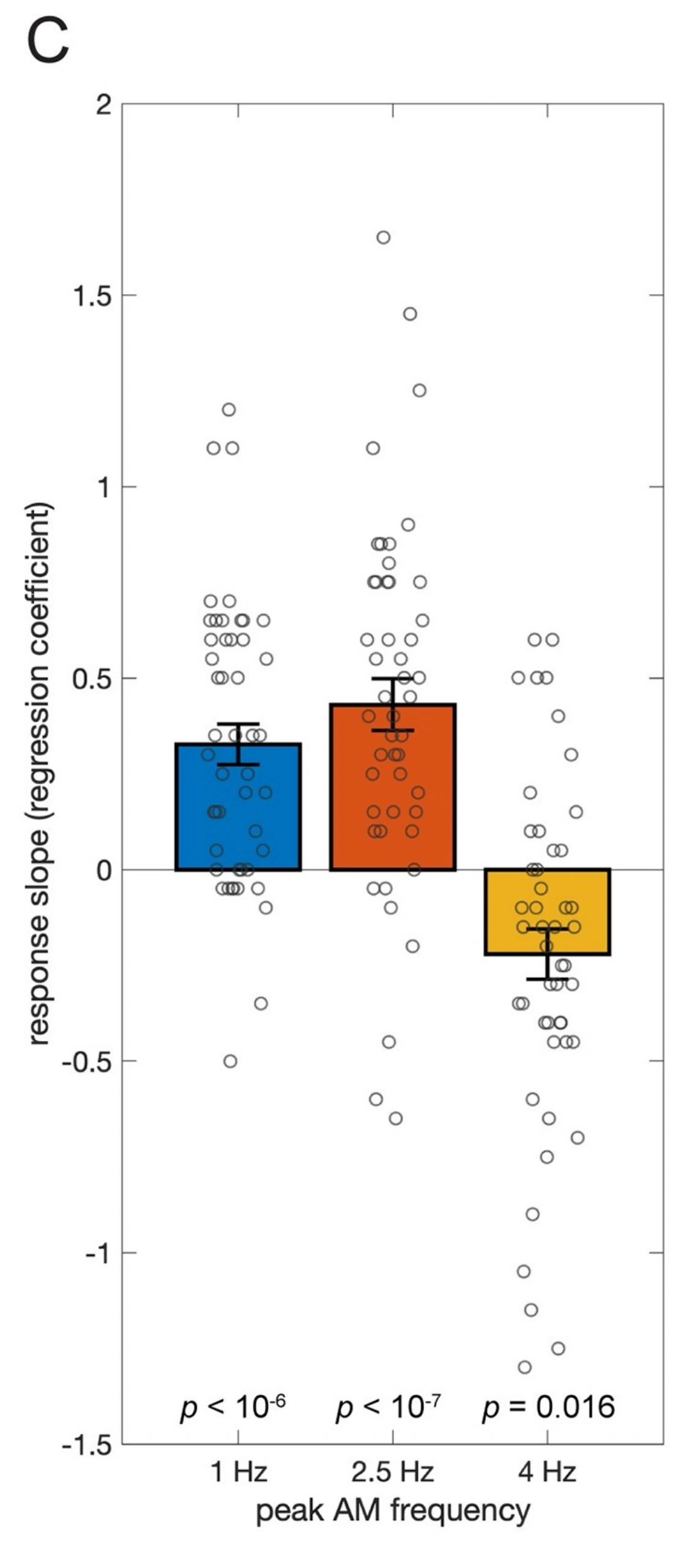
How can we tell music from speech before recognizing words or a melody? Experiments with artificial sounds showed that faster loudness fluctuations encouraged speech judgments, while more regular fluctuations encouraged music judgments—revealing a simple acoustic cue that helps separate the two.

Summary bars and participant points show how temporal irregularity changes music-versus-speech judgments at 1, 2.5, and 4 hertz, with response-slope axes, uncertainty bars, and p-values.
Figure 3C
2024

Toward reliable signals decoding for electroencephalogram: A benchmark study to EEGNeX

Chen, X., Teng, X., Chen, H., Pan, Y., & Geyer, P.

Biomedical Signal Processing and Control, 87, 105475.

Journal article

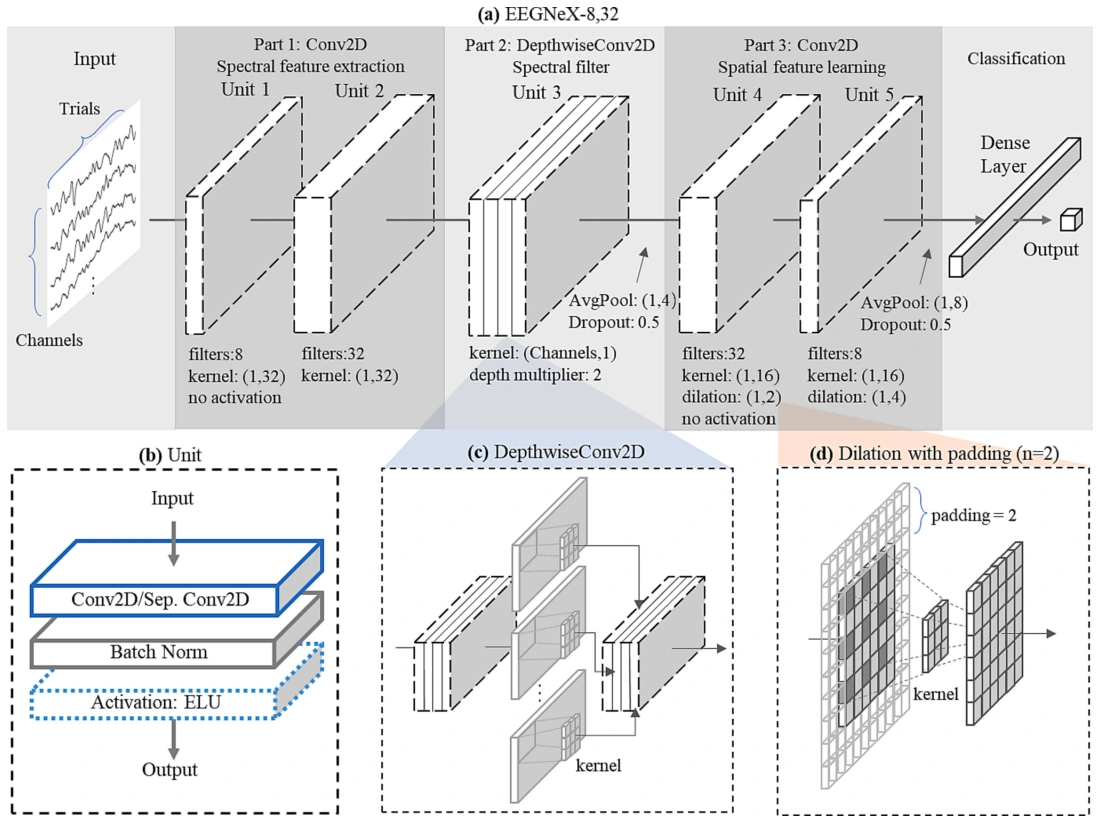
This study compared ways for computer models to recognize patterns in electrical brain recordings. Its EEGNeX model outperformed the comparison methods on the tested brain–computer interface benchmarks, including imagined-movement tasks, and the researchers released the models to help others reproduce and extend the work.

Published EEGNeX architecture diagram shows five network units, the convolution-block structure, depthwise convolution, and dilated convolution.
Figure 4
2021

Modulation Spectra Capture EEG Responses to Speech Signals and Drive Distinct Temporal Response Functions

Teng, X., Meng, Q., & Poeppel, D.

eNeuro, 8(1), ENEURO.0399-20.2020.

Journal article

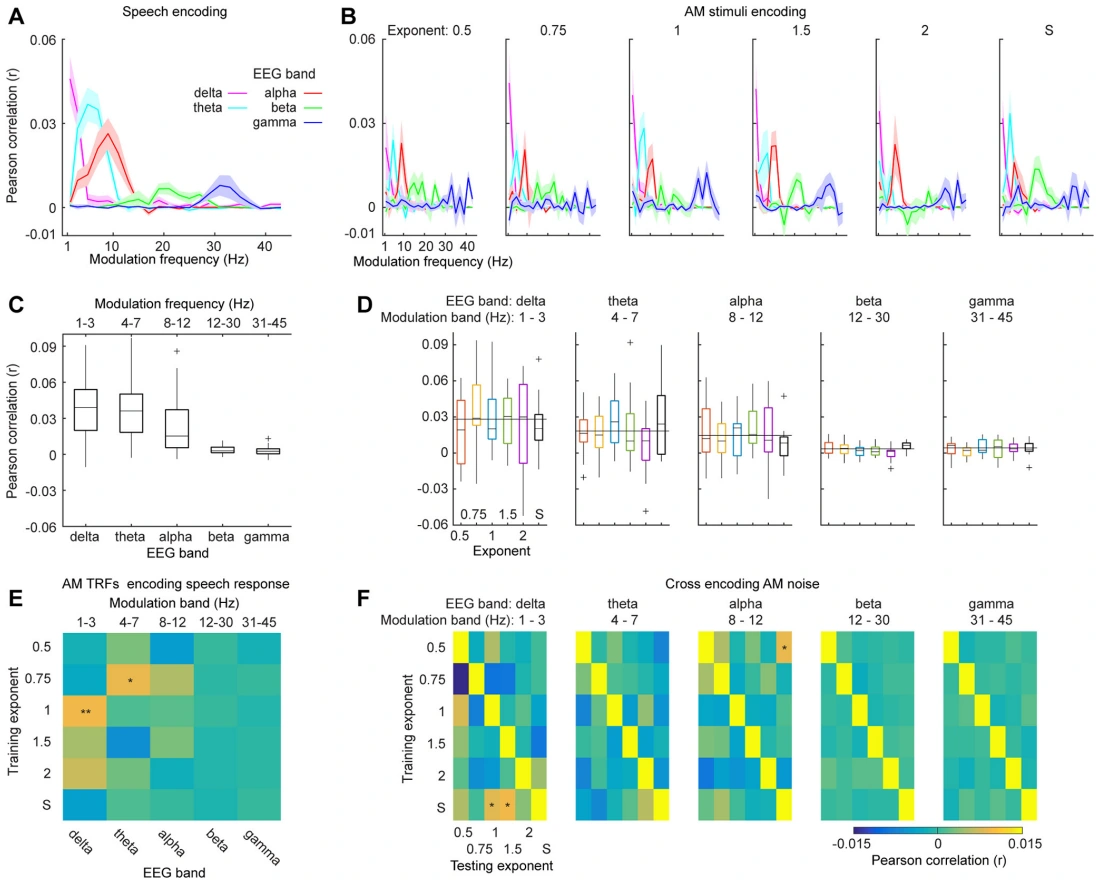
The study asked whether our hearing system is especially sensitive to the patterns of loudness change found in speech. Brain-response models built from artificial noises with speech-like timing patterns predicted responses to real speech better than several alternatives, suggesting that basic sound dynamics help organize speech processing.

Encoding-result line plots, boxplots, and cross-encoding heatmaps compare speech and amplitude-modulated sounds across neural frequency bands.
Figure 4
2020

Constrained Structure of Ancient Chinese Poetry Facilitates Speech Content Grouping

Teng, X., Ma, M., Yang, J., Blohm, S., Cai, Q., & Tian, X.

Current Biology, 30(7), 1299-1305.e7.

Journal article

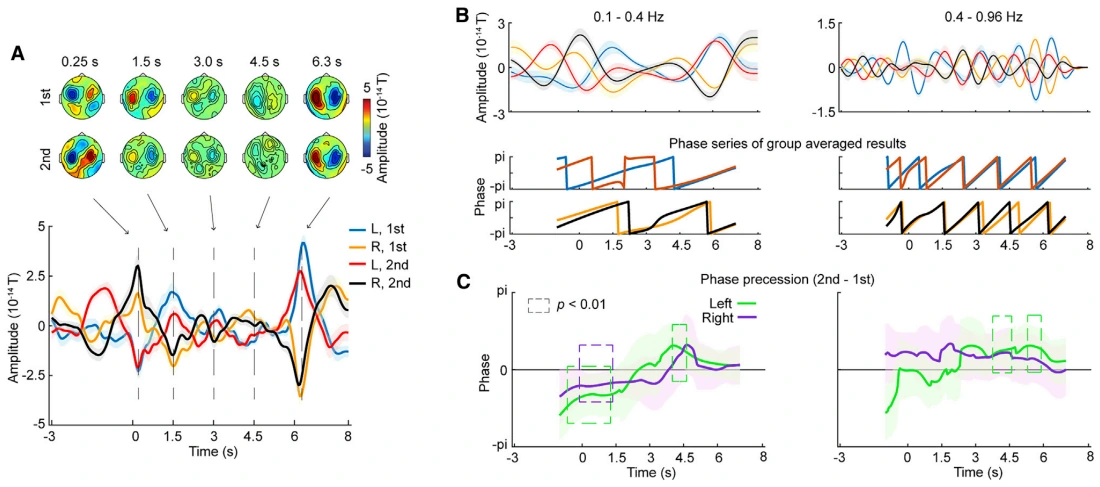
How do listeners follow a poem when its language differs from everyday speech? Brain recordings showed that people used their knowledge of classical Chinese poetic structure to group words into lines and anticipate what came next.

Scalp maps and neural response curves compare first and second poem presentations; phase plots show how response timing changes across the poem.
Figure 3
2020

Theta and Gamma Bands Encode Acoustic Dynamics over Wide-ranging Timescales

Teng, X., & Poeppel, D.

Cerebral Cortex, 30(4), 2600-2614.

Journal article

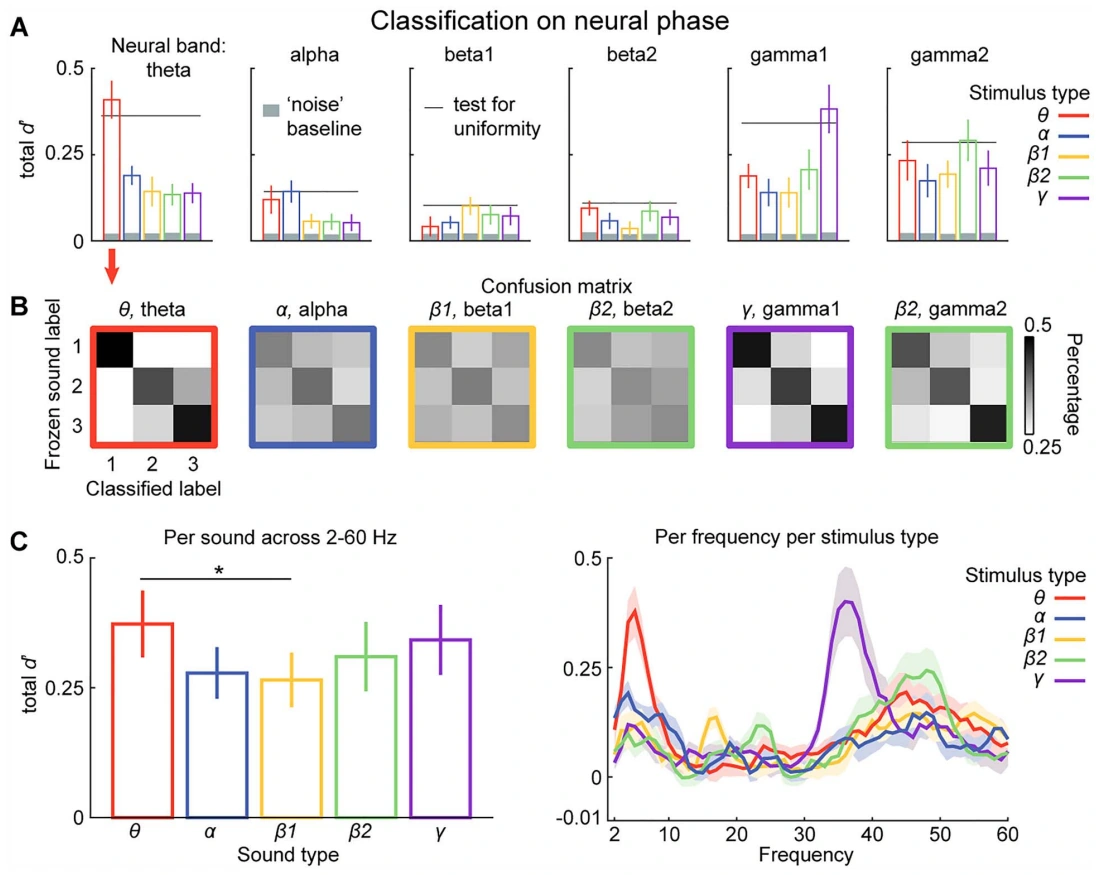
How does the brain represent sounds that change at very different speeds? MEG recordings showed that two ranges of brain rhythms, theta and gamma, carried information across the tested speeds more effectively than the rhythms between them, suggesting that hearing relies on two preferred processing timescales.

Classification scores, confusion matrices, and frequency curves show how MEG phase information distinguishes sounds in different neural bands.
Figure 3
2020

Entrainment in Human Auditory Cortex: Mechanism and Functions

Poeppel, D., & Teng, X.

In B. Fritzsch (Ed.), The Senses: A Comprehensive Reference (2nd ed., pp. 63-76). Elsevier.

Book chapter

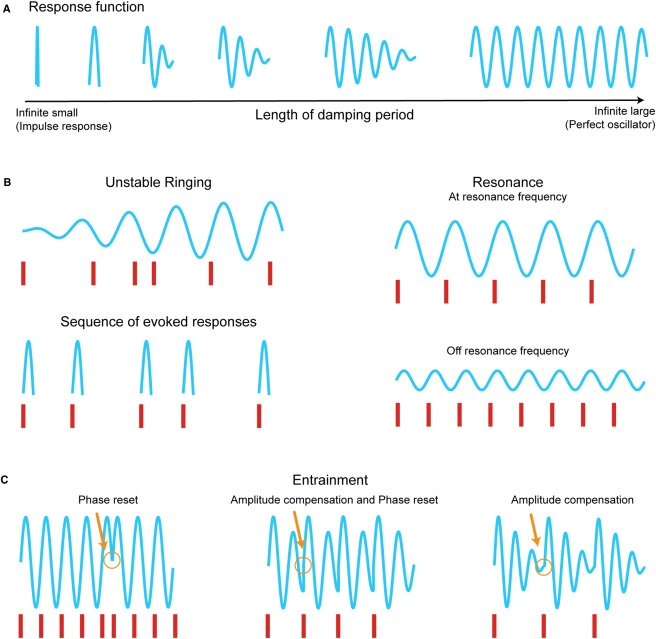
This review examines how brain activity aligns with the timing of sounds, a process called auditory entrainment. It compares related mechanisms and considers what this alignment contributes to hearing, highlighting questions for future research.

Published schematic illustrates damping duration, unstable ringing, sequences of evoked responses, resonance, and entrainment by phase and amplitude adjustments.
Figure 1 - mechanism diagram
2020

On Multi-Scale Processing in the Auditory System

Teng, X., & Poeppel, D.

Proceedings of e-Forum Acusticum 2020, 1407-1408.

Conference contribution

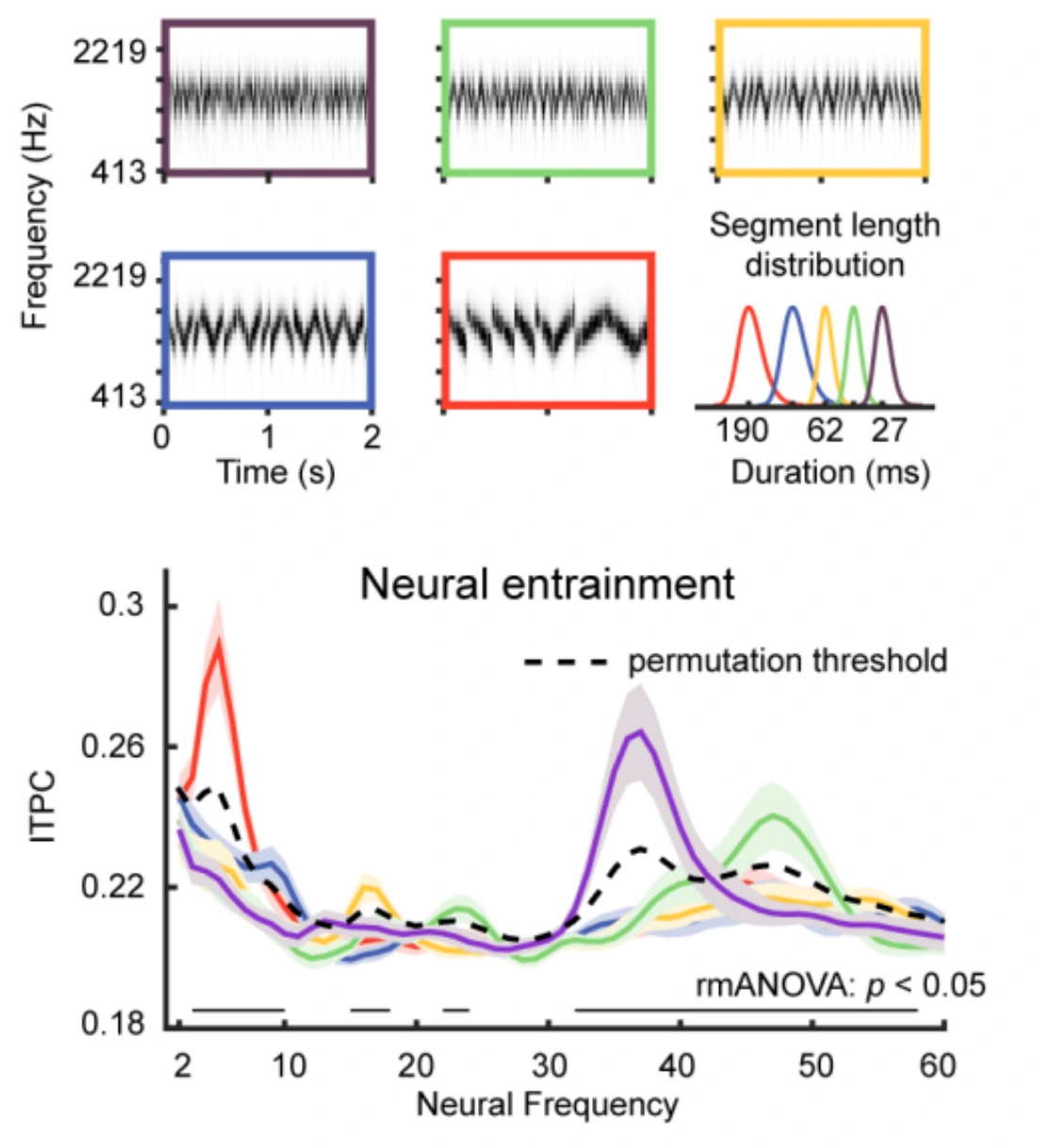
This conference paper reviews how hearing combines rapid details with slower sound patterns. Listening experiments and brain recordings support two preferred timescales, roughly 30 and 200 milliseconds, helping explain how we can hear small changes while also recognizing a sound as a whole.

Five example sound spectrograms and their segment-duration distributions appear above neural entrainment curves plotted against frequency, preserving the original axes and color legend.
Figure 2
2019

Speech fine structure contains critical temporal cues to support speech segmentation

Teng, X., Cogan, G. B., & Poeppel, D.

NeuroImage, 202, 116152.

Journal article

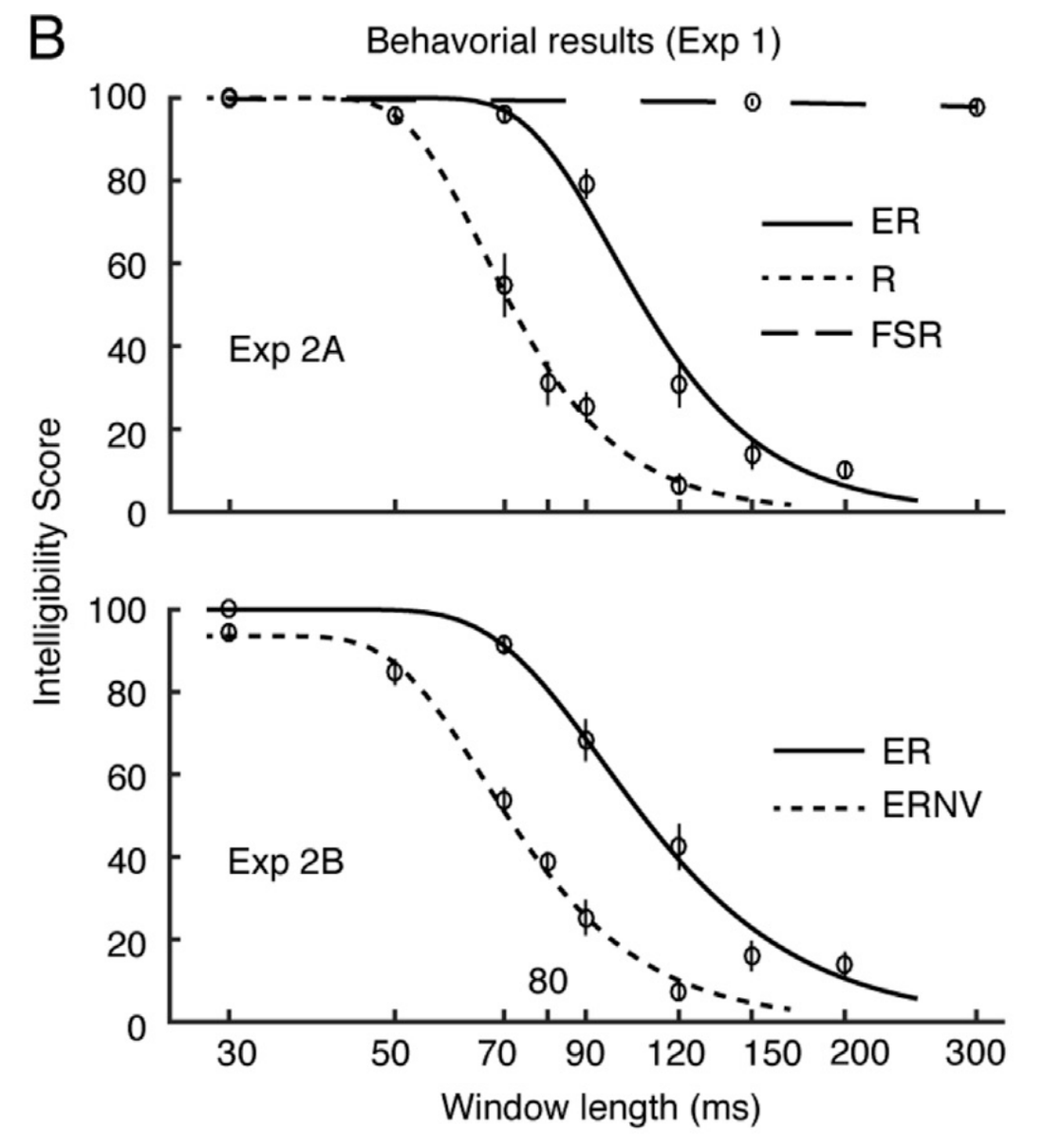
What helps us split continuous speech into understandable pieces? Brain recordings and listening tests showed that fine details of speech carry useful timing cues, helping people understand speech even when its usual loudness pattern is disrupted.

Two line plots of speech intelligibility against reversal-window length, comparing acoustic components.
Figure 3B
2019

Experimental evidence on computational mechanisms of concurrent temporal channels for auditory processing

Teng, X., Poeppel, D.

Proceedings of the 2019 Conference on Cognitive Computational Neuroscience, 393-394.

Conference contribution

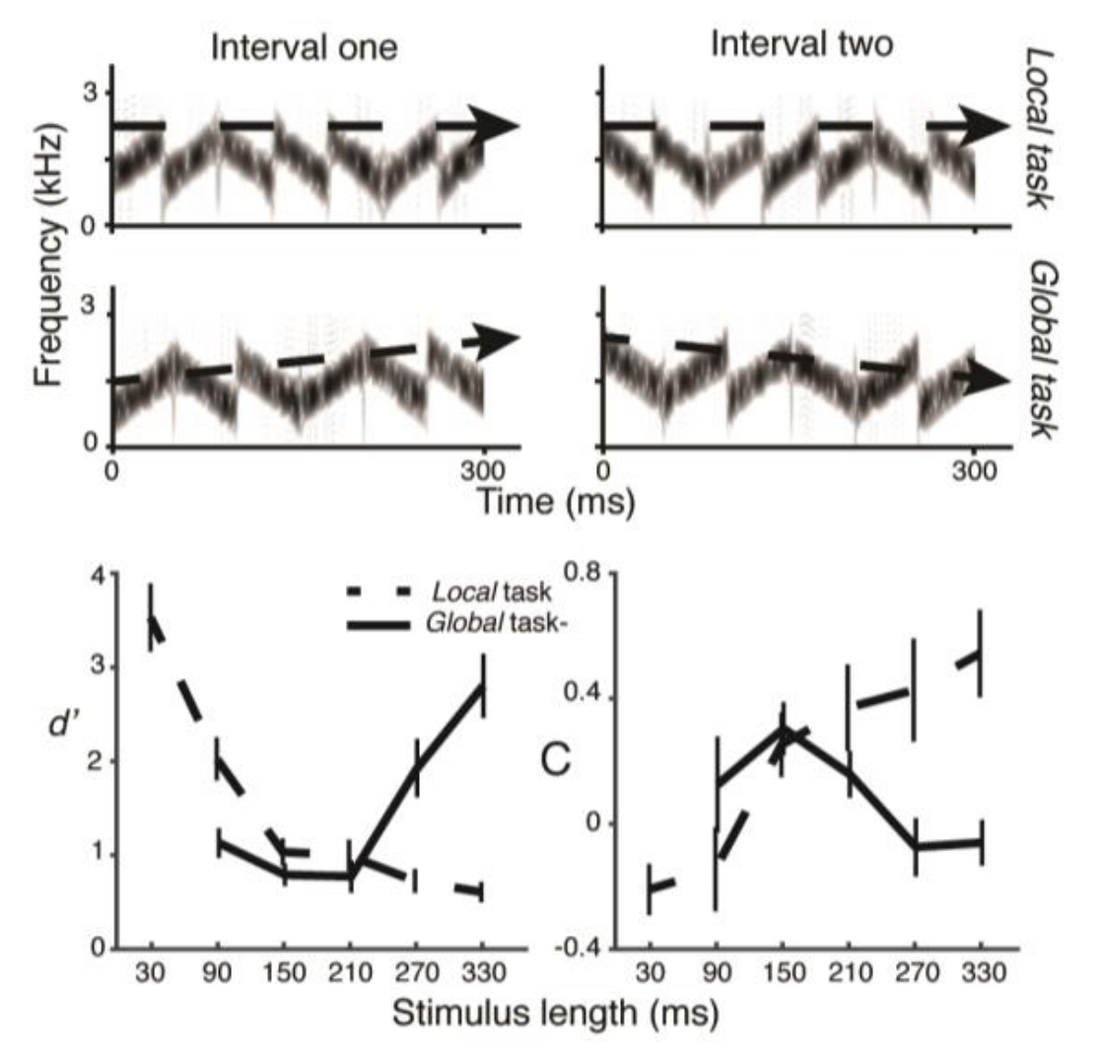
This conference paper brings together evidence that hearing uses short time windows for fine details and longer ones for overall sound patterns. It links these two scales to brain rhythms and proposes a computational model to investigate how combining them supports sound recognition.

Sound spectrograms and behavioral curves comparing local-detail and global-pattern listening tasks.
Figure 1
2019

Reverberant speech recognition with actual cochlear implants: verifying a pulsatile vocoder simulation method

Kong, F., Wang, X., Teng, X., Zheng, N., Yu, G., & Meng, Q.

Proceedings of the 23rd International Congress on Acoustics, 3109-3112.

Conference contribution

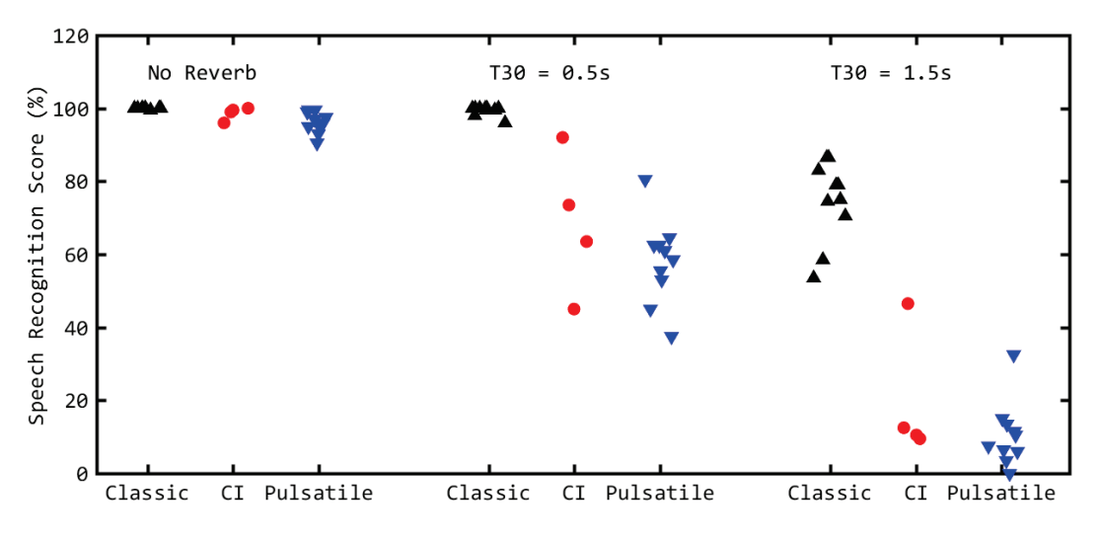
Can computer simulations accurately predict how cochlear implant users understand speech in echoing rooms? This conference study found that a newer simulation based on brief sound pulses more closely matched actual implant users, while a conventional simulation made performance look too good.

Speech-recognition scores for classic vocoder, cochlear implant and pulsatile-vocoder groups at three reverberation levels.
Figure 2
2019

Trial-by-trial voxelwise noise correlations improve population coding of orientation in human V1

Zhang, R.-Y., Wei, X.-X., Teng, X., & Kay, K.

Proceedings of the 2019 Conference on Cognitive Computational Neuroscience, 721-724.

Conference contribution

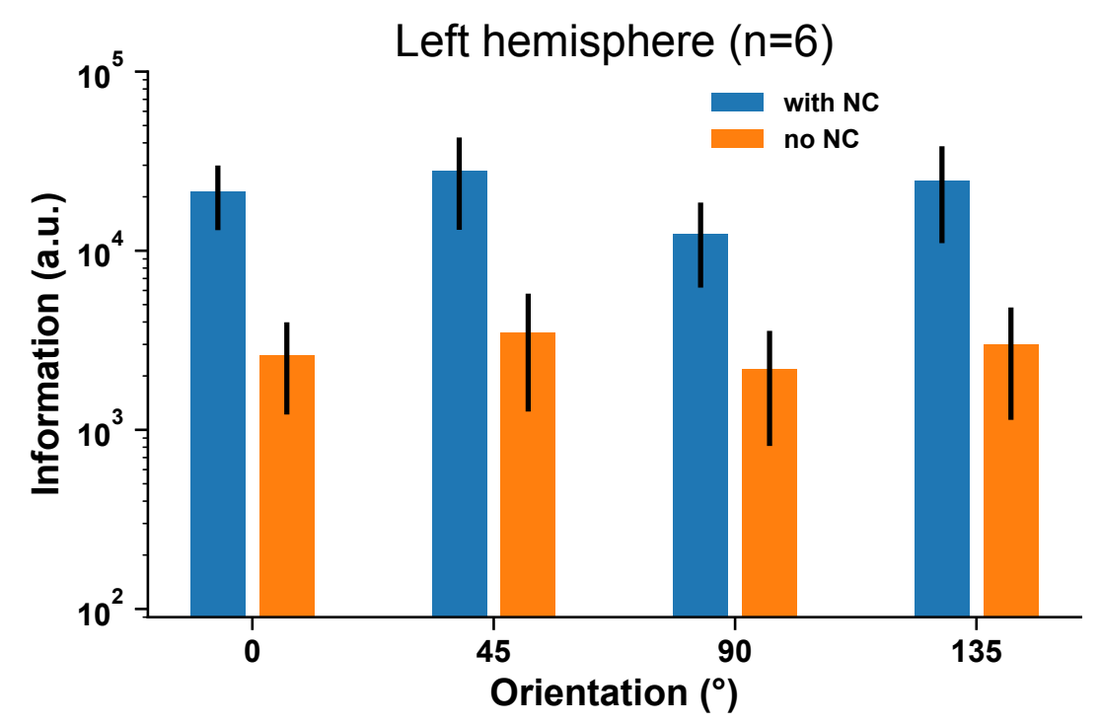
Do shared fluctuations in brain scans always obscure useful information? This conference study found that preserving correlations between small regions of visual cortex helped distinguish the orientations of viewed patterns; removing those correlations in a simulation substantially reduced the information available.

Blue and orange bars compare orientation information with versus without noise correlations at four orientations.
Figure 2, left panel
2018

Imagined speech influences perceived loudness of sound

Tian, X., Ding, N., Teng, X., Bai, F., & Poeppel, D.

Nature Human Behaviour, 2(3), 225-234.

Journal article

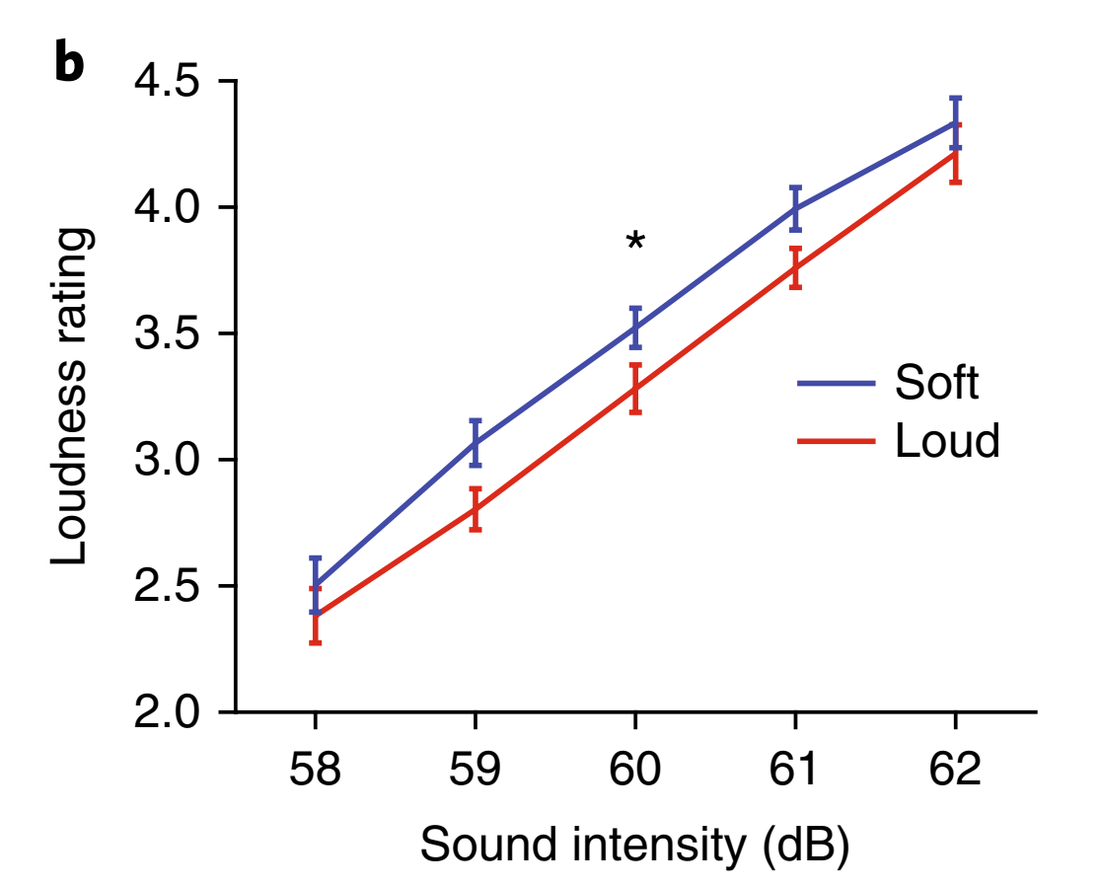
Can the voice in your head change what you hear? Participants rated a real sound as softer after imagining speaking loudly than after imagining speaking softly, and brain recordings linked this change to early stages of auditory processing.

Red and blue curves show loudness ratings after imagining loud or soft speech across five sound intensities.
Figure 1b
2018

Temporal order judgment reveals local-global auditory processes

Teng, X., Sun, Y., & Poeppel, D.

Acta Acustica united with Acustica, 104(5), 817-820.

Journal article

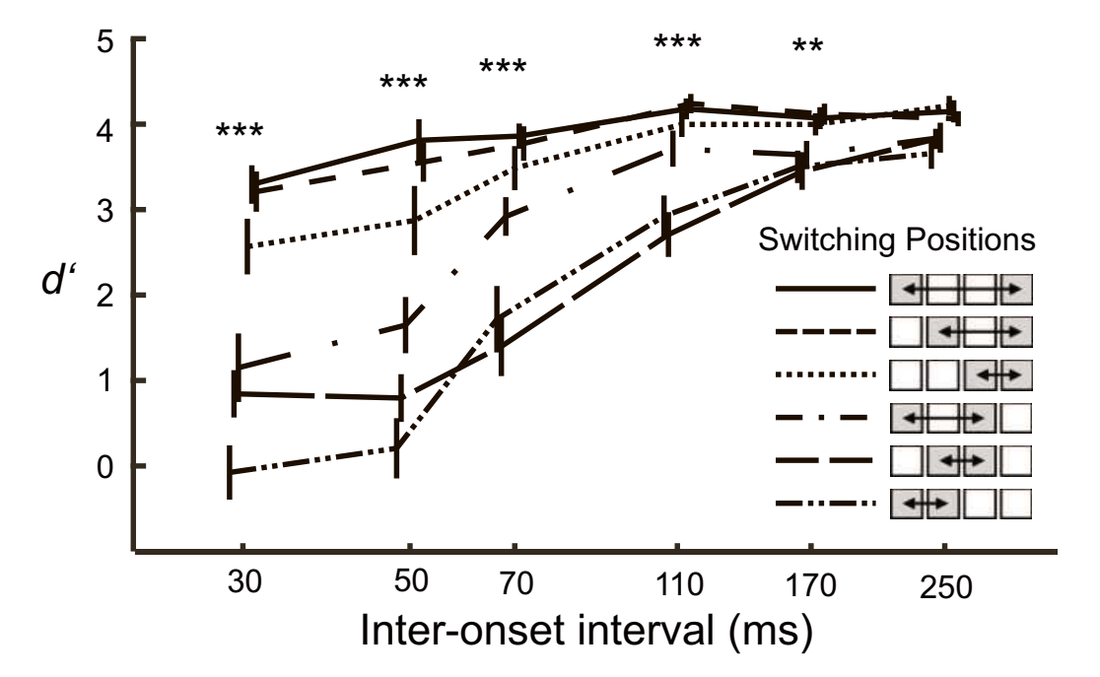
How do we tell which speech sounds came first? Listening tests with short vowel sequences showed that people use the overall sound pattern as well as individual details, with the balance changing when the gaps between sounds grow longer.

Performance curves for six vowel-switching positions across increasing inter-onset intervals.
Figure 2, result panel
2018

Theta band oscillations reflect more than entrainment: behavioral and neural evidence demonstrates an active chunking process

Teng, X., Tian, X., Doelling, K., & Poeppel, D.

European Journal of Neuroscience, 48(8), 2770-2782.

Journal article

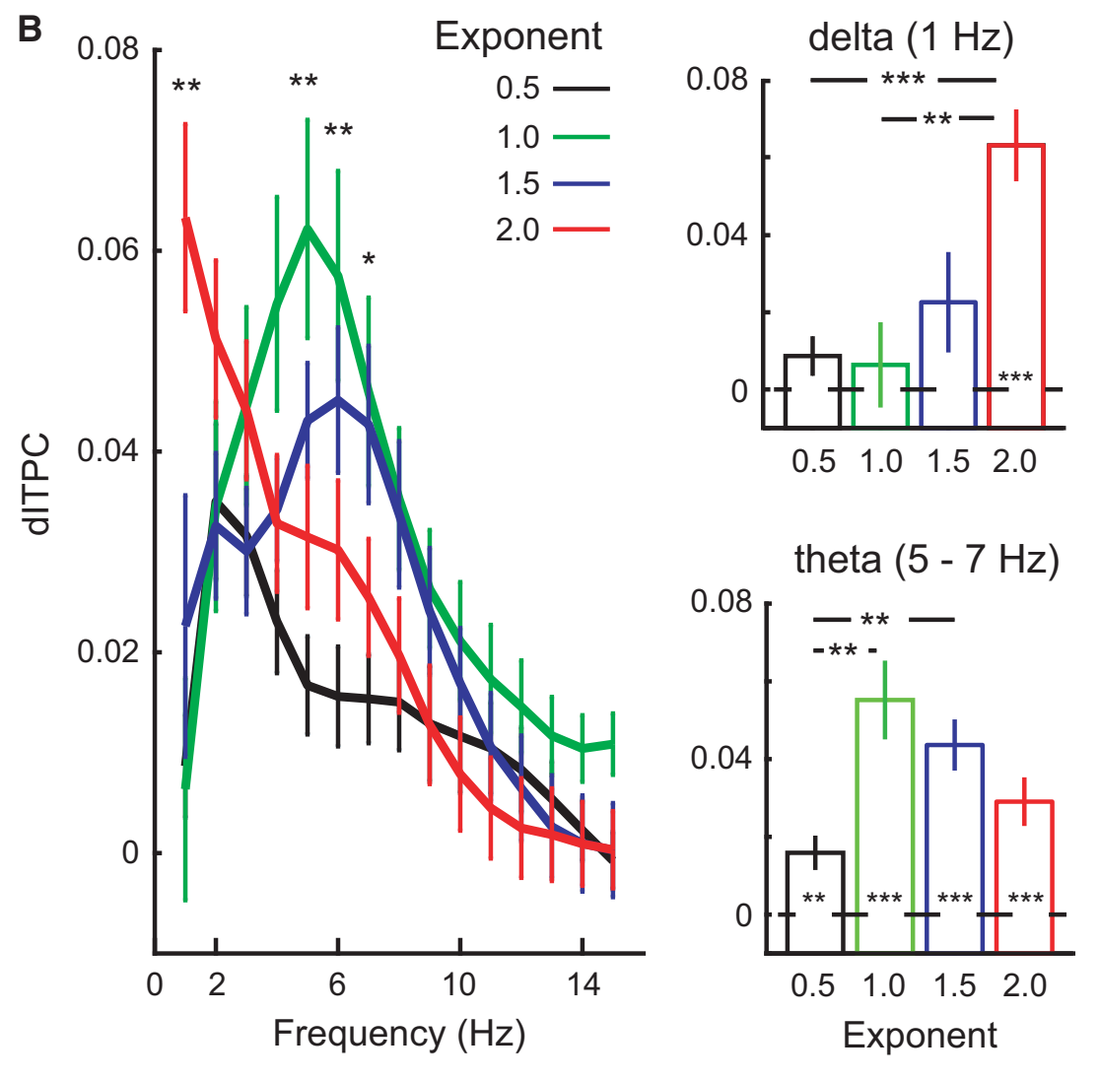
Does the brain simply follow rhythms in sound, or does it organize sound for itself? Even sounds without a regular beat produced reliable theta-band responses, supporting the idea that the auditory system actively groups information into chunks lasting roughly a fifth of a second.

Frequency-response curves and delta/theta summary bars show differentiated inter-trial phase coherence for four sound conditions.
Figure 3B
2017

Concurrent temporal channels for auditory processing: Oscillatory neural entrainment reveals segregation of function at different scales

Teng, X., Tian, X., Rowland, J., & Poeppel, D.

PLOS Biology, 15(11), e2000812.

Journal article

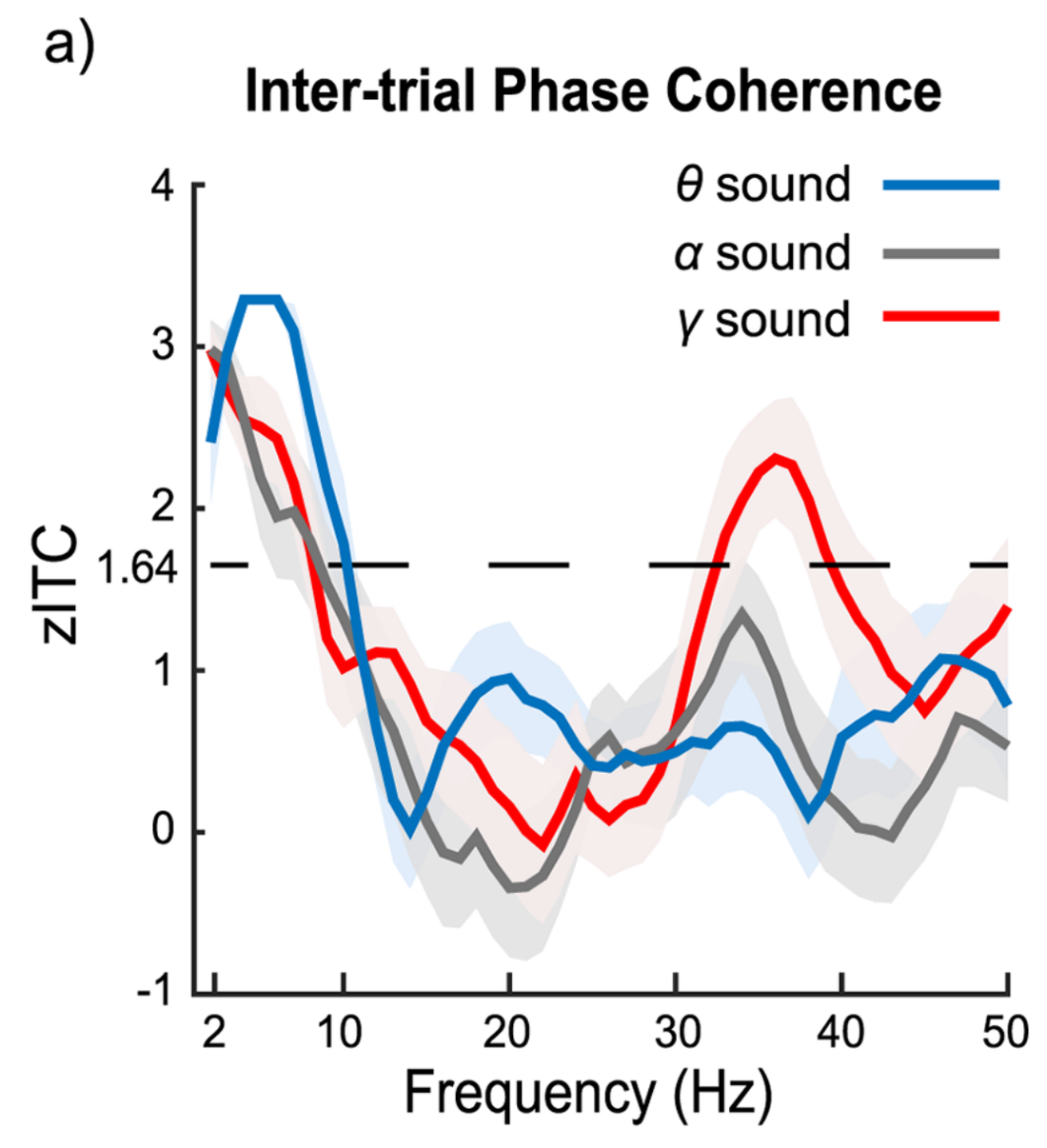
How does hearing handle both rapid details and slower changes in sound? MEG recordings showed that the brain preferentially tracked information at a fast and a slow timescale, rather than treating all speeds equally, supporting two complementary channels for auditory processing.

Phase-coherence spectra for theta-, alpha- and gamma-range sounds, with peaks at slow and fast frequencies.
Figure 2a, upper panel
2016

Testing multi-scale processing in the auditory system

Teng, X., Tian, X., & Poeppel, D.

Scientific Reports, 6, 34390.

Journal article

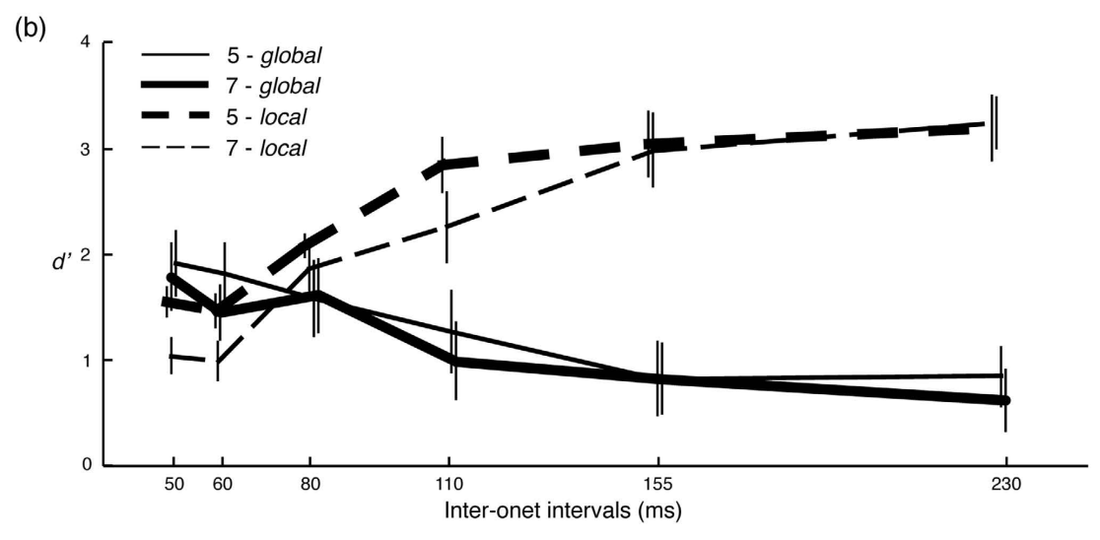
Does listening for longer always help us hear more detail? Experiments found that longer sounds improved recognition of overall patterns but did not improve fine-detail judgments, suggesting that hearing combines short windows for details with longer windows for the bigger picture.

Four behavioral curves compare local and global listening tasks as intervals between sound segments increase.
Figure 3b
2012

Adding irrelevant information to the content prime reduces the prime-induced unmasking effect on speech recognition

Wu, M., Li, H., Gao, Y., Lei, M., Teng, X., Wu, X., & Li, L.

Hearing Research, 283(1-2), 136-143.

Journal article

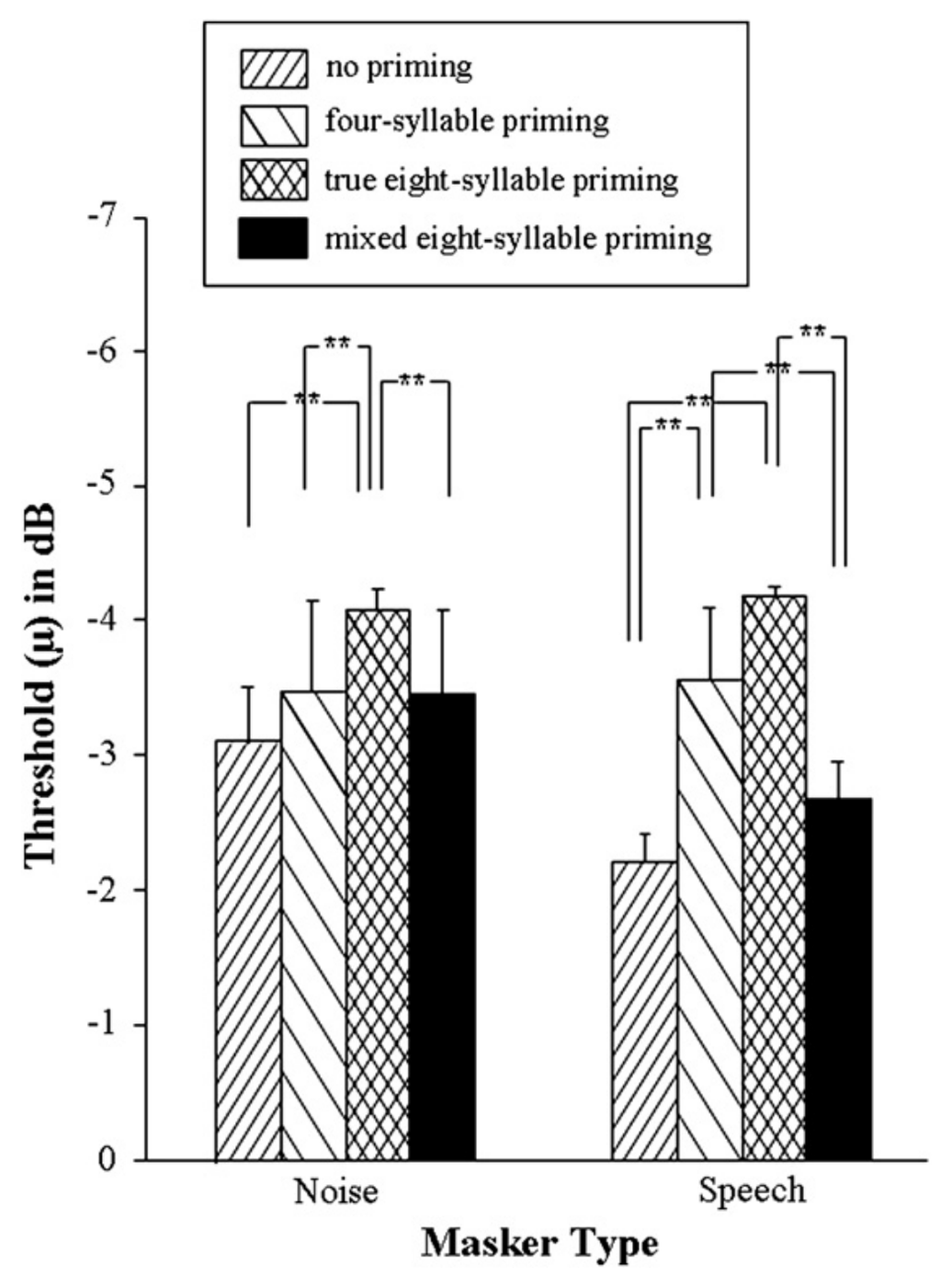
Hearing the beginning of a sentence in advance can help us pick out later words among competing voices. This study found that adding unrelated syllables to that preview erased the benefit, showing that extra information can interfere with useful listening cues.

Threshold bars compare four speech-priming conditions under noise and competing-speech masking.
Figure 5

Updated 10 November 2026. Summaries describe the linked papers; preprints have not yet completed journal peer review. PDF links identify author manuscripts or preprints where applicable.