
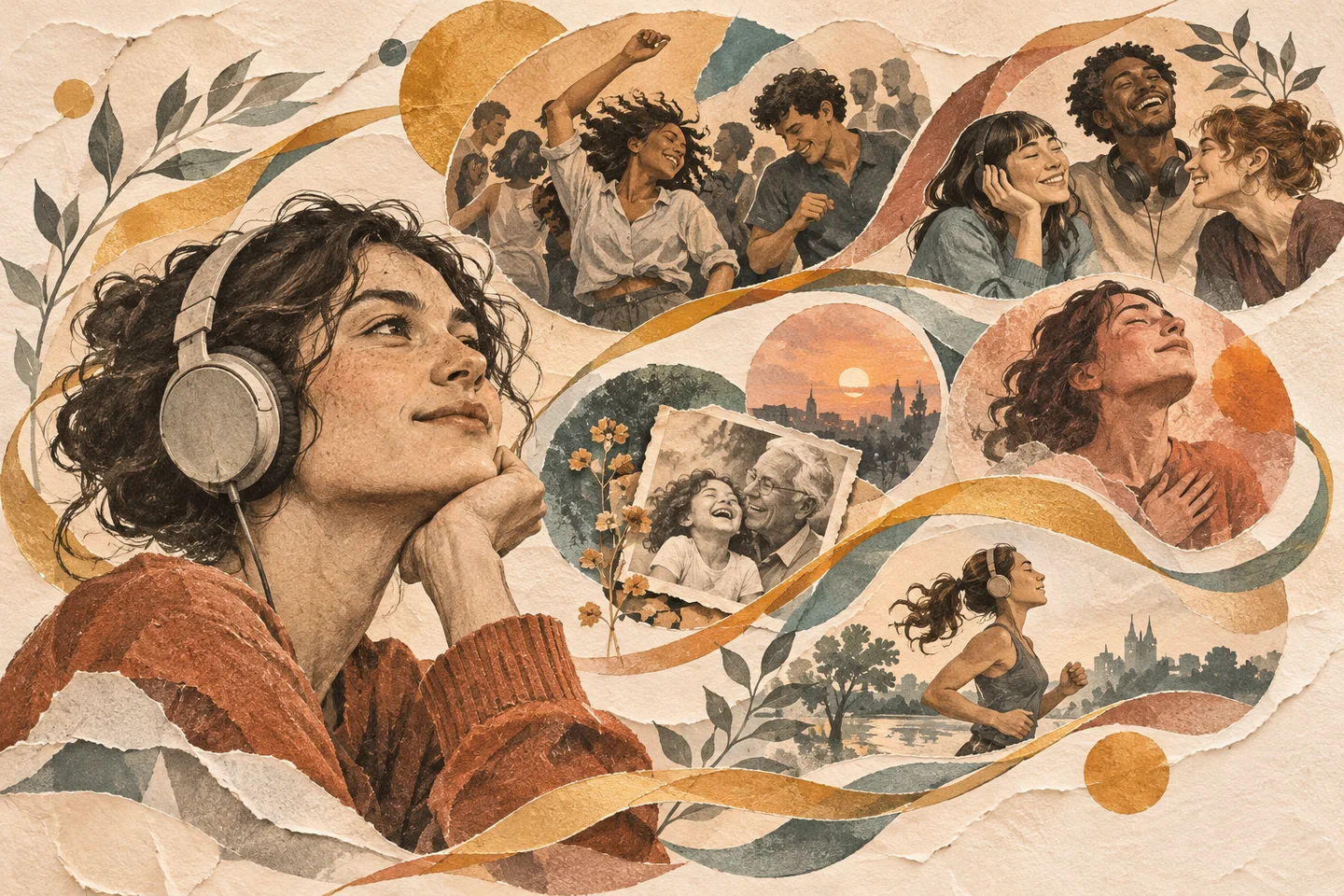
A song cannot pay the rent or answer an email. Yet we reach for one on the way to work, while writing, after a disappointment, or when we want to remember someone. A concert can become a landmark in a person’s life. A familiar melody can make an ordinary afternoon feel connected to years before.
Music asks a curious question of psychology. Why do people devote so much time, emotion, and ingenuity to arranging sounds? The opening class of PSYC3440 Psychology of Music begins there. Before learning the names of brain regions or discussing musical notation, we consider an experience nearly everyone brings into the room: being moved by something they hear.
Begin with the listener
You do not need to read a score to study music psychology. Listening already gives you questions. Why does one sequence of sounds feel musical? Why does a beat invite movement? Why can the same song comfort one person and leave another untouched? Each question connects an everyday experience with a problem we can investigate.
Consider the places music turns up. People sing to babies who cannot yet understand the words. Families choose songs for weddings and funerals. Religious communities sing together; schools and nations use songs to express belonging. These uses suggest that music can help people organize feelings, relationships, and shared occasions. Understanding them means paying attention to the listener and the situation as well as the sound.
Entertainment itself deserves explanation. If an experience matters enough for people to seek it repeatedly, build rituals around it, and pass it between generations, psychologists have something to learn. Pleasure, memory, identity, and companionship are substantial parts of human life.
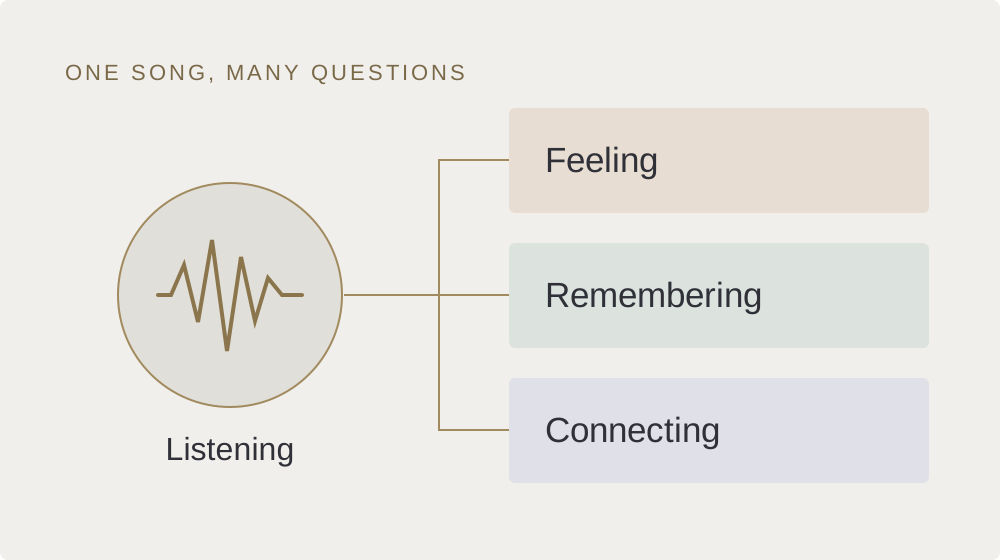
Three routes from an everyday experience to a research question. Conceptual illustration.
A message from Earth
One example from the first class takes this question far beyond the classroom. The Voyager spacecraft carry Golden Records intended to introduce something of Earth to anyone who might encounter them. Alongside images, natural sounds, and spoken greetings are musical selections from different cultures and eras. NASA describes the records as a time capsule of our world.
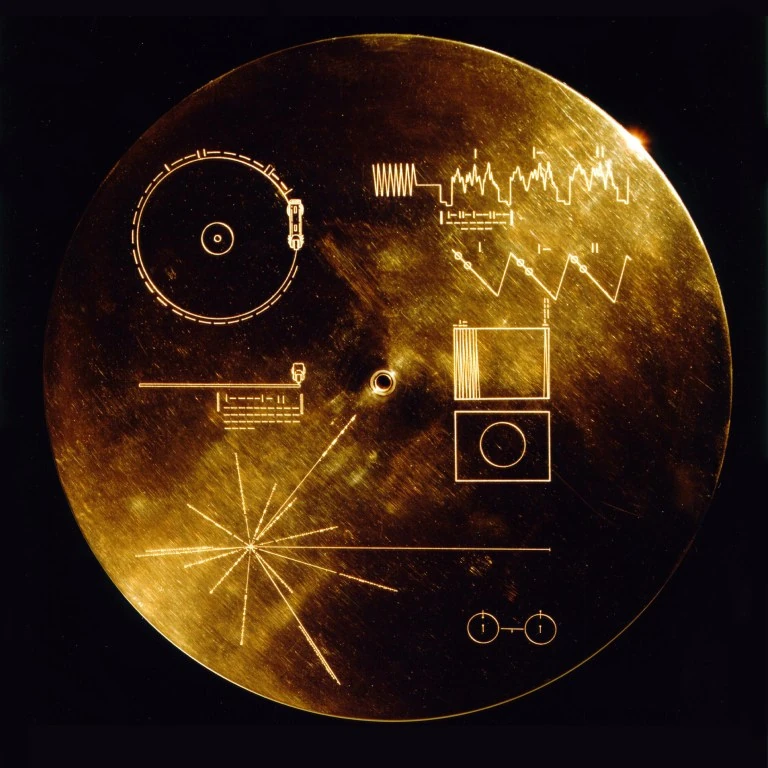
The cover of the Voyager Golden Record, whose contents include music selected to represent life on Earth. Image: NASA/JPL. About the record and its cover.
The choice is revealing. Asked how to represent ourselves in a limited collection of sounds and images, we included music. In the course, this becomes an invitation to think about what music expresses: our ability to organize time, create beauty, celebrate, mourn, and make something meaningful together.
That interpretation is a starting point for discussion. The record does not settle a scientific argument about music’s purpose. It makes the puzzle vivid. Sound can carry more than a description of the world; people also use it to convey what living in that world feels like. Why should organized sound serve us so well in that task?
Three ways to ask why
The course introduces three broad ways of thinking about music’s place in human life. They offer different questions to test, and none provides a settled explanation on its own.
The first considers music as a possible biological adaptation. Perhaps some musical capacities helped our ancestors survive, reproduce, care for children, or maintain social relationships. A caregiver’s singing offers one line of inquiry: could patterns of pitch, repetition, and rhythm help sustain attention or connection before language develops? Singing and moving together raise another: could coordinated activity help a group stay together?
These are hypotheses about origins. Observing that people use music socially today does not, by itself, establish why musical abilities evolved. The attraction of the adaptation approach is that it makes connections between musical behavior and fundamental problems of human life. Its challenge is to explain those connections with evidence.
A second approach treats music as a cultural invention that draws on existing capacities. Human beings already hear patterns, remember sequences, move, imitate, and respond emotionally. Music may combine these abilities into a particularly compelling experience. Writing provides a useful comparison in the original lesson: a cultural practice can bring several mental systems into a new arrangement. Music’s value would then lie partly in what people learned to do with capacities they already possessed.
A third possibility asks how biology and culture might shape one another over time. Once a musical practice enters childcare, education, ceremonies, or social life, it changes the experiences through which people learn. Those experiences can shape listening habits, preferences, and behavior. Gene–culture coevolution is the broader proposal that cultural practices and biological evolution can interact. Establishing such an account for music requires evidence beyond showing that musical tastes are learned.
These perspectives can illuminate different aspects of the same phenomenon. A lullaby, a dance, and a private playlist may pose related questions without sharing one simple explanation.
A meeting place for disciplines
Following those questions brings several fields into conversation. Psychology studies perception, emotion, learning, and memory. Neuroscience asks how hearing, movement, and reward systems participate. Linguistics considers what music and language share as patterns unfolding in sound and time. Anthropology brings attention to cultural practices and the different musical worlds people grow up in.
Each perspective changes what we notice. A familiar song might prompt a question about memory, about the expectations built into its rhythm, or about the community in which it became familiar. A satisfying explanation may need several of these perspectives together. The course aims to build that habit of looking across disciplines while remaining precise about what each can tell us.
Start with your own playlist
The next question can begin close to home. Choose a song you return to for a particular reason. When do you play it? What do you expect it to do? Does it remind you of a person, a period of life, or a group you belong to? Would someone with a different background hear the same thing in it?
These observations give inquiry a place to begin. Music psychology turns a familiar pleasure into questions about how people create meaning, anticipate events, remember their lives, and connect with others. Studying why a song moves us is one way to study the human mind.
Adapted in English from “Why study music, psychology, and the brain?”, SMRT Lab, 5 May 2026, based on PSYC3440 Psychology of Music. English adaptation prepared with AI.