

A melody reaches us one moment at a time. By the time the next sound arrives, the previous one has already gone. Yet we hear more than a succession of disconnected events: a passage gathers momentum, an ending approaches, and a new beginning becomes possible. Music seems to hold the recent past and the near future together.
The original WeChat article called this a kind of time machine. A 2024 study by Xiangbin Teng, Pauline Larrouy-Maestri, and David Poeppel investigated one part of that metaphor: how listeners organize a continuous musical stream into phrases, and whether brain activity carries signs of anticipating their boundaries.
Hearing the shape of a phrase
A musical phrase is a group of notes that feels like a meaningful stretch of a larger piece. Think of a sentence spoken aloud: its shape depends on relationships among words, not simply on the arrival of one sound after another. A phrase can similarly create a sense of departure, movement, and arrival.
Sometimes an ending announces itself through a pause or a prolonged note. But music also has less obvious clues. Chords create relationships that can give a passage direction, even when no silence marks its destination. Researchers wanted to know whether the brain could follow that larger organization over several seconds.
Keeping time with beats would not, by itself, answer the question. Someone can tap along without identifying where one phrase ends and another begins. The challenge was to find a neural measure sensitive to these longer units, while separating their structure from the individual sounds that carry it.
Taking Bach apart, carefully
Bach’s four-part chorales offered a useful starting point. Their relatively clear, regular phrases and harmonic organization made it possible to change specific features while retaining recognizably musical material. EEG, recorded from electrodes on the scalp, allowed the team to examine brain activity throughout the listening experience.
The analysis included 29 listeners aged 18–34, recruited in Germany. After a separate practice piece, they heard versions of ten chorales at three tempos. Their task was to listen and rate how much they liked each piece. They were not asked to guess the next note.
The researchers first removed prominent timing cues to phrase endings, including pauses and note prolongations. They also ensured that each beat had a note onset. The aim was to reduce easy acoustic signposts so that harmonic relationships could play a larger role.
Then came two carefully controlled rearrangements. In local reversal, the first and last beats of a phrase stayed in place, while the intervening beats changed order. An eight-beat phrase numbered 1–8 became 1, 7, 6, 5, 4, 3, 2, 8. In global reversal, the order of beats across the entire piece was reversed. Individual beat waveforms were preserved; this was not a recording played backwards.
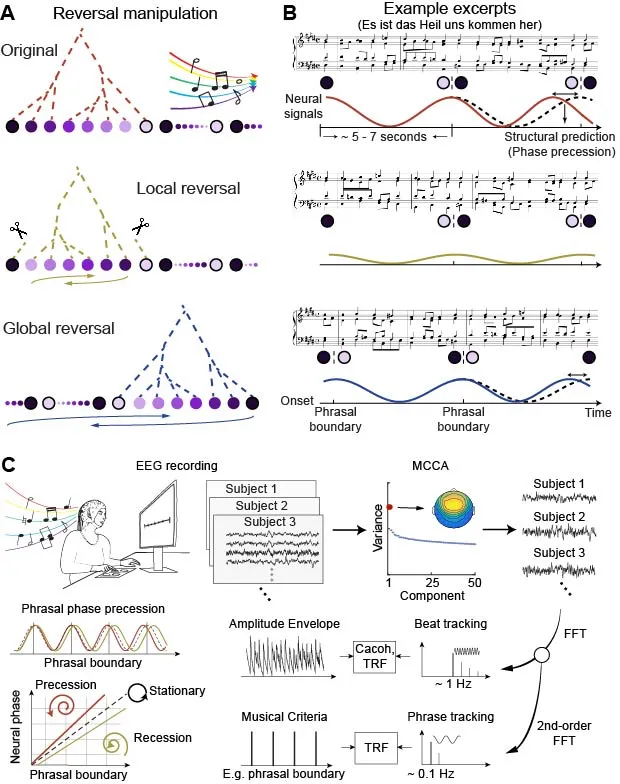
The musical manipulations and EEG analysis workflow, with schematic predictions in the upper-right panel. Figure 1 from Teng, Larrouy-Maestri and Poeppel (2024), reproduced from the original WeChat article. © 2024 the authors. Open figure.
These comparisons addressed different possibilities. Preserving boundary beats tested whether those conspicuous events alone could explain phrase tracking. Reversing the whole sequence retained a different, potentially usable harmonic progression. Neither manipulation simply replaced music with random noise.
A slower rhythm in the response
The researchers first found neural responses tracking notes and beats, broadly consistent with earlier work. The more unusual result appeared when they examined how the strength of beat-related EEG activity changed over time.
That strength rose and fell on a much slower timescale, around the rate of musical phrases: roughly a tenth of a cycle per second. Instead of looking only at activity following each beat, the analysis asked whether its changing intensity reflected the organization of a whole passage.
This is the idea behind “gain modulation.” An amplifier can change the strength of a signal without changing its underlying rhythm. Here, the term describes how a faster neural response was modulated over a longer musical unit. The original article’s image of an internal volume control makes the idea approachable, although EEG did not reveal a literal control knob or establish which brain region operated it.
Phrase-related modulation remained detectable after reversal. Its timing and strength nevertheless differed across conditions; an analysis around phrase boundaries found a larger response for the original music than for local reversal. That pattern supports a contribution from harmonic progression beyond the regularly recurring boundary beats.
When the response begins to lead
Tracking a phrase is one question. Anticipating its ending is another. To investigate the distinction, the team examined the timing, or phase, of the slower modulation as successive phrases unfolded.
Imagine two repeating patterns initially keeping pace. If one gradually moves ahead of the other, their changing alignment becomes informative. In the original-order chorales, the phrase-related neural pattern advanced relative to the musical boundaries as the piece continued. A similar tendency appeared in global reversal, while local reversal tended to lag. The researchers called the advancing pattern “phrasal phase precession.”
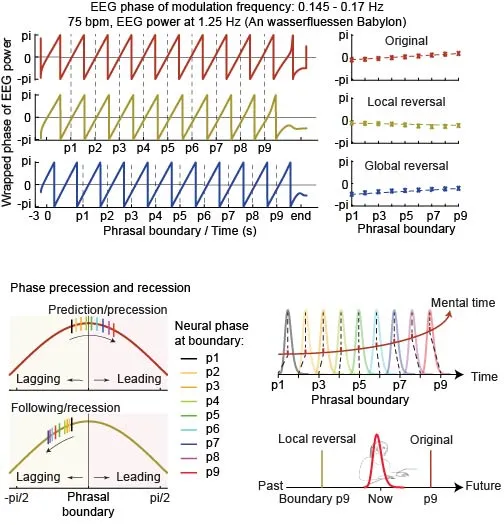
Phase timing for an example chorale (top), with diagrams explaining the proposed relationship between neural timing and phrase boundaries (bottom). Selected panels from Figure 5, as arranged in the original WeChat article. Teng, Larrouy-Maestri and Poeppel (2024). © 2024 the authors. Open figure.
Because the original and locally reversed phrases retained the same boundary beats, comparing them offered a way to ask whether the musical route between those boundaries helped establish an expectation.
They interpreted the pattern as evidence consistent with listeners building structural expectations from the unfolding music. The account concerns anticipation of phrase boundaries. It does not show that the researchers could read which particular note a listener expected, or that every listener consciously knew when an ending would arrive.
What remains to be heard
The evidence also leaves questions open. Phase precession was estimated from EEG averaged across listeners, which limits conclusions about individual differences. Across all nine pieces used in that comparison, the overall effect of reversal condition fell short of conventional statistical significance. It became significant after one piece showing an opposite pattern was excluded. That sensitivity warrants further testing.
The material was deliberately chosen for clear structures within Western tonal music. Other traditions, irregular phrases, and listeners with different musical backgrounds could reveal where the account generalizes. The proposed roles of particular brain regions also remain hypotheses to investigate.
The immediate contribution is a way to study how listening connects events over several seconds. When a musical ending feels close, the experience offers a familiar starting point for a difficult scientific question: how does a mind turn passing sound into an unfolding whole?
Adapted and expanded in English from Xiangbin Teng’s SMRT Lab WeChat article of 10 July 2024. Study details were checked against Teng, Larrouy-Maestri, and Poeppel (2024), Segmenting and Predicting Musical Phrase Structure Exploits Neural Gain Modulation and Phase Precession, The Journal of Neuroscience, doi:10.1523/JNEUROSCI.1331-23.2024. Explore the materials and analysis code. English adaptation prepared with AI.